Friday, January 27, 2006

HRW World Report 2006

Human Rights Watch released its annual report on human rights last week. The United States comes in for significant criticism. The press release accompanying the report's publication states,

New evidence demonstrated in 2005 that torture and mistreatment have been a deliberate part of the Bush administration’s counterterrorism strategy, undermining the global defense of human rights, Human Rights Watch said today in releasing its World Report 2006.

The evidence showed that abusive interrogation cannot be reduced to the misdeeds of a few low-ranking soldiers, but was a conscious policy choice by senior U.S. government officials. The policy has hampered Washington’s ability to cajole or pressure other states into respecting international law, said the 532-page volume’s introductory essay.

For an overview of the report's conclusions regarding human rights practices in the U.S., go here. To order the report or download the PDF version, go here.

[UPDATE: Today the International Herald Tribune discusses the Human Rights Watch World Report 2006 in an editorial entitled "An Indictment of America." It begins:

When Human Rights Watch, a respected organization that has been monitoring the world's behavior since 1978, focuses its annual review on America's use of torture and inhumane treatment, every American should feel a sense of shame. And everyone who has believed in the United States as the staunchest protector of human rights in history should be worried.

Many nations--Belarus, Uzbekistan, Zimbabwe, Myanmar, Cuba, Sudan and China to name only some of the worst--routinely trample on human rights in a way that neither the United States nor any of its allies would ever countenance. But the United States wrote the book on human rights; it defined the alternative to tyranny and injustice. So when the vice president of the United States actually lobbies against a bill that bans "cruel, inhuman, and degrading treatment," Human Rights Watch is justified in delivering harsh criticism.

The entire editorial is available here.]

Monday, January 23, 2006

Is Bush a Wilsonian?

George W. Bush has spoken grandiloquently about the need to spread democracy throughout the Middle East. He has been pilloried by realists for failing to assess and employ American power effectively. Could it be that he is, in fact, a Wilsonian?

G. John Ikenberry takes up the question in this interesting essay.

"Vast, Lawless Areas"

The lines on a map tell us which state is legally entitled to exercise sovereignty over a particular territory, but they say nothing about whether that authority translates into effective control.

The Rio Grande, from El Paso to the Gulf of Mexico, become the southern boundary of the United States in 1845 when Texas was admitted to the Union as the 28th state. Almost forty years later, the absence of effective control over vast stretches of West Texas was acknowledged when the county commissioners of Pecos County appointed a notorious drunk and small-time thief to be justice of the peace. Thus Judge Roy Bean came to be the "Law West of the Pecos," dispensing beer and frontier justice from the porch of a saloon called the Jersey Lilly.

Developing states, like the United States in the nineteenth century, often include what are effectively ungoverned territories in which lawlessness (or its alternative, frontier justice) is the norm. The same is true of states in the middle of a war.

A story in yesterday's New York Times reminds us that Pakistan is a state lacking effective control over parts of its territory. Carlotta Gall and Mohammad Khan write,

Two years after the Pakistani Army began operations in border tribal areas to root out members of Al Qaeda and other foreign militants, Pakistani officials who know the area say the military campaign is bogged down, the local political administration is powerless and the militants are stronger than ever.

Both Osama bin Laden, who released a new audiotape of threats against the United States this week, and his deputy, Ayman al-Zawahiri, are believed to be living somewhere in the seven districts that make up these tribal areas, which run for more than 500 miles along the rugged Afghan border and have been hit by several American missile strikes in recent weeks.

The officials said they had been joined by possibly hundreds of foreign militants from Arab countries, Central Asia and the Caucasus, who present a continuing threat to the authorities within the region.

The tribal areas are off limits to foreign journalists, but the Pakistani officials, and former residents who did not want to be identified for fear of retribution, said the militants--who call themselves Taliban--now dispensed their own justice, ran their own jails, robbed banks, shelled military and civilian government compounds and attacked convoys at will. They are recruiting men from the local tribes and have gained a hold over the population through a mix of fear and religion, the officials and former residents said.

As in Texas west of the Pecos during the 1880s and 1890s, a semblance of government exists in the tribal areas of Pakistan, but it is not an authority that is responsive to Gen. Pervez Musharraf's government in Islamabad and its avowed determination to root out members of Al Qaeda from the border regions. This is why the United States felt compelled to use an unmanned Predator aircraft to attack a suspected Al Qaeda meeting place in Bajaur on January 13. On one level, the attack was a violation of Pakistan's sovereignty (as the anti-American demonstrations that followed pointed out), but on another level complaints about the violation of Pakistani sovereignty are clearly divorced from the reality on the ground.

In what must be considered an early contender for the understatement of the year, an American military official, speaking on condition of anonymity, told the New York Times, "With vast, lawless areas in which Taliban-style justice holds sway, Pakistan faces serious challenges."

Pakistan's challenges, however, are ones that America and the world also face. In the 1880s, the crime that occurred in ungoverned territories was, for the most part, a local problem. Not any more. Thanks to all those factors that together create what we call globalization, Pakistan's ungoverned tribal regions are right next door to all of us.

Saturday, January 21, 2006

An Event at Dutton's

Dan Caldwell and I will be at Dutton's Brentwood Bookstore tomorrow (Sunday) at 2:00 p.m. discussing Seeking Security in an Insecure World. Please stop by if you're in the area.

Iraq: A New Estimate

In Tuesday's Los Angeles Times (I'm still trying to get caught up), Linda Bilmes and Joseph Stiglitz presented a brief overview of a paper they recently presented at the annual meeting of the American Economic Association (available here). As entertaining as Freakonomics may be and as helpful as it may be to have some numbers available when arguing public policy, I am generally skeptical of the economists' faith in their own ability to assign particular values to almost everything--including human lives. Still, Bilmes--a former assistant secretary of Commerce--and Stiglitz--winner of the 2001 Nobel Prize in economics--make a compelling argument for considering more than just the direct costs of the war, which are currently moving beyond $250 billion.

The argument, reduced to its simplest (i.e., monetary) terms, is this: The final cost to the United States of the war in Iraq is likely to be between $1 trillion and $2 trillion dollars. The wide range of the estimate is primarily due to the war's uncertain duration. The longer the United States is in Iraq, the closer we'll come to the $2 trillion figure.

For those who are inclined to judge the war in Iraq in terms of cost-benefit analysis, having a comprehensive accounting of the costs is an essential starting point.

Friday, January 20, 2006

MLK and Nonviolence

It has been a busy week, so here at the end of it I need to do some catching up.

One thing I failed to post earlier this week was a link to a wonderful essay by Taylor Branch published in the New York Times on Martin Luther King, Jr. Day. Branch, who has recently published At Canaan's Edge, the third volume in his monumental biography of Dr. King, describes the way that King and the movement he led employed the core values of America and a deep commitment to nonviolence to transform our nation and the world. He laments the fact, however, that we have largely abandoned King's legacy and that we have failed to see the utility of King's methods for our present struggles:

Only hours before his death, Dr. King startled an aide with a balmy aside from his unpopular movement to uplift the poor. "In our next campaign," he remarked, "we have to institutionalize nonviolence and take it international."

The nation would do well to incorporate this goal into our mission abroad, reinforcing the place of nonviolence among the fundamentals of democracy, along with equal citizenship, self-government and accountable public trust. We could also restore Dr. King's role in the continuing story of freedom to its rightful prominence, emphasizing that the best way to safeguard democracy is to practice it. And we must recognize that the accepted tradeoff between freedom and security is misguided, because our values are the essence of our strength. If dungeons, brute force and arbitrary rule were the keys to real power, Saudi Arabia would be a model for the future instead of the past.

Much of this bears repeating, but perhaps no line moreso than this one: "The best way to safeguard democracy is to practice it." The pithy expression is Branch's, but the lesson it conveys is Dr. King's.

It is a lesson that our generation needs to re-learn.

Wednesday, January 18, 2006

Conference Call

Dan Caldwell and I will be discussing our new book, Seeking Security in an Insecure World, on a conference call tomorrow (Thursday) morning beginning at 9:00 a.m. Pacific Time. The call, sponsored by the Council on Foreign Relations, will involve groups from twenty colleges and universities around the country.

If any readers of Swords Into Plowshares have an opportunity to participate in the call, please let us know that you're on. And if you don't have a chance to make your comment or ask your question, feel free to use the comment space here to do so.

Tuesday, January 17, 2006

Domestic Surveillance and "Necessity"

When legal arguments fail, "necessity" is often the justification of those who are determined to act with or without the law. As Oliver Cromwell put it, "Necessity hath no law." But, as William Pitt (the younger) recognized, because it is unbound by law, necessity is also "the argument of tyrants."

Most of the actions taken by the Bush Administration that have most seriously damaged the reputation of the United States as a nation committed to the defense of human rights and individual freedoms have, at one time or another (and often repeatedly), been presented as being necessary to the defense of Americans. Like all consequentialist claims, these are very difficult claims to assess, particularly when an extraordinary degree of secrecy--extraordinary for a democracy, at least--is also presented as a necessity in the "war on terrorism."

Today's New York Times offers a bit of evidence on which we can begin to assess the argument that the Bush Administration's domestic surveillance program--the one that evades both the Fourth Amendment and FISA--is necessary. Consider this extended excerpt:

In the anxious months after the Sept. 11 attacks, the National Security Agency began sending a steady stream of telephone numbers, e-mail addresses and names to the F.B.I. in search of terrorists. The stream soon became a flood, requiring hundreds of agents to check out thousands of tips a month.

But virtually all of them, current and former officials say, led to dead ends or innocent Americans.

F.B.I. officials repeatedly complained to the spy agency that the unfiltered information was swamping investigators. The spy agency was collecting much of the data by eavesdropping on some Americans' international communications and conducting computer searches of phone and Internet traffic. Some F.B.I. officials and prosecutors also thought the checks, which sometimes involved interviews by agents, were pointless intrusions on Americans' privacy.

As the bureau was running down those leads, its director, Robert S. Mueller III, raised concerns about the legal rationale for a program of eavesdropping without warrants, one government official said. Mr. Mueller asked senior administration officials about "whether the program had a proper legal foundation," but deferred to Justice Department legal opinions, the official said.

President Bush has characterized the eavesdropping program as a "vital tool" against terrorism; Vice President Dick Cheney has said it has saved "thousands of lives."

But the results of the program look very different to some officials charged with tracking terrorism in the United States. More than a dozen current and former law enforcement and counterterrorism officials, including some in the small circle who knew of the secret program and how it played out at the F.B.I., said the torrent of tips led them to few potential terrorists inside the country they did not know of from other sources and diverted agents from counterterrorism work they viewed as more productive.

"We'd chase a number, find it's a schoolteacher with no indication they've ever been involved in international terrorism--case closed," said one former F.B.I. official, who was aware of the program and the data it generated for the bureau. "After you get a thousand numbers and not one is turning up anything, you get some frustration."

Journalists, no matter how resourceful and thorough, will never be able to offer the public a definitive assessment of the efficacy of an operation like this one. What they can do (and, in this case, have done) is to raise questions about the veracity of an important claim being presented to the public. The next step is for Congress to use its oversight function to get to the bottom of the story in a way that journalists, being unable to compel testimony, cannot.

Next month, as the Senate Judiciary Committee takes up the constitutionality of the Bush Administration's domestic surveillance program, Congress also needs to begin asking questions, behind closed doors if necessary, about the claim that the program has saved "thousands of lives."

Monday, January 16, 2006

MLK on Love and Justice

"Power at its best is love implementing the demands of justice. Justice at its best is love correcting everything that stands against love."

--Martin Luther King, Jr., Where Do We Go from Here: Chaos or Community? (1967)

[via Central Dallas Ministries]

Sunday, January 15, 2006

The Imperial Presidency

An editorial in today's New York Times is unusually blunt in its criticisms of President Bush, who, according to the piece, "seems to see no limit to his imperial presidency." This is a point that has been made previously with respect to President Bush by Arthur M. Schlesinger, Jr., the author of the classic work entitled The Imperial Presidency. Schlesinger's original argument, summarized in a more recent book he wrote entitled War and the American Presidency, is this:

Confronted by presidential initiatives in foreign affairs, Congress and the courts, along with the press and the citizenry too, often lack confidence in their own information and judgment and are likely to be intimidated by executive authority. The inclination in foreign policy is to let the president have the responsibility and the power--a renunciation that results from congressional pusillanimity as well as from presidential rapacity.

The imperial presidency is, or ought to be, a matter of concern to both Republicans and Democrats who believe the system of checks and balances on which the Constitution is based is worth preserving. After all, "congressional pusillanimity" at present is Republican pusillanimity. Thus far, however, most Republicans in Congress--with the noteworthy exception of Sen. John McCain--have willingly acquiesced in almost every post-9/11 expansion of presidential authority. Fortunately, Sen. Arlen Specter has promised to hold hearings in the Senate Judiciary Committee on the legality of President Bush's domestic eavesdropping. But whether those hearings will represent a reassertion of legislative authority or merely the appearance of a genuine check on the executive remains to be seen.

Friday, January 13, 2006

The Judgment of Other Nations

In The Federalist No. 63, James Madison wrote,

An attention to the judgment of other nations is important to every government for two reasons. The one is, that, independently of the merits of any particular plan or measure, it is desirable, on various accounts, that it should appear to other nations as the offspring of a wise and honorable policy; the second is, that in doubtful cases, particularly where the national councils may be warped by some strong passion or momentary interest, the presumed or known opinion of the impartial world may be the best guide that can be followed.

At the White House today, Chancellor Angela Merkel of Germany reiterated her call for the prison at Guantanamo to be closed. President Bush, still convinced that there is some benefit to the United States to having a prison available beyond the jurisdiction of American courts, demurred.

When "the judgment of other nations" calls the United States to be faithful to its own highest values, it would be good to pay attention.

Monday, January 02, 2006

Syriana

The plot of Syriana brings together a number of touchy issues in American foreign policy--arms transfers, covert operations, and Middle Eastern oil politics, to name but a few. Also included are the income gap in the Middle East, terrorism, torture, and assassination as a tool of state policy. The highly combustible mix has confused some reviewers (those unable to keep up) and offended others (those unable to face reality). Both groups probably need either to grow up or to stick to films from Disney.

Is the plot real? No, not in the sense of being a faithful depiction of historical events. But the significant plot elements all have parallels in the recent history of American foreign policy. The investigation of the U.S. intelligence community conducted by the Church Committee in the 1970s, the congressional investigation of the Iran-Contra affair in the 1980s, and the 9/11 Commission’s investigation of events leading up to the terrorist attacks on the United States in 2001 all could have supplied inspiration for the screenplay (although former CIA agent Robert Baer’s book See No Evil is cited in the film’s credits).

What seems to bother some conservatives most about Syriana is its suggestion that the government of the United States might engage in morally dubious activities for the sake of maintaining American access to Middle Eastern oil. Others seem troubled by the connection drawn in the film between dismal social conditions and the recruitment of suicide bombers. Two very carefully researched books--Michael Klare’s Blood and Oil and Daniel Benjamin and Steven Simon’s The Age of Sacred Terror--offer ample evidence to validate both points.

Syriana may lack subtlety and it may have some loose ends in the plot, but its fundamental problem is its message: The United States is heavily dependent on Middle Eastern oil and that dependence necessitates significant compromises with what we proclaim to be our values. Most Americans would rather not be told that.

Sunday, January 01, 2006

Coming Attractions

Having given the blog a holiday break, I'm back. This New Year's Day post will, however, be brief--merely a preview of coming attractions. Here are a few of the things I plan to write about in the coming days:

First, two recent movies--Syriana and Munich--are well worth discussing. I plan to look at both from an IR perspective.

Second, I'll be looking back at some of the better books that I read during 2005. Expect a few recommendations.

Third, a play I saw this afternoon at the Mark Taper Forum--Lewis and Clark Reach the Euphrates--suggested some interesting questions about the history of American foreign policy and Thomas Jefferson's notion of an "Empire of Liberty." I hope to look at the historical record and see if we can find some of the roots of what playwright Robert Schenkkan calls "the divided heart of America."

Fourth, fifth, sixth, seventh, etc.--there remains much to be said about torture, the Bush Administration's domestic spying, homeland security failures, the disparagement of international law, and the increasingly ambitious attempts by the Bush Administration to revive the "imperial presidency" cut short by the resignation of Richard Nixon in 1974.

The new year may not be pretty, but it will certainly be interesting.

Monday, December 19, 2005

Christmas Break

In spite of the fact that I have a lot more I want to say about the President Bush's determination that the Fourth Amendment doesn't apply to his administration, I must leave the commenting to others for now. The grades are all in and it's time for a break. I'll resume posting on or about January 1.

Thanks for stopping by. Have a very merry Christmas!

Saturday, December 17, 2005

Fool Me Once

No matter how things turn out in Iraq--and all people of good will must hope that a generation of Iraqis that has lived through three devastating wars and a long and brutal dictatorship will find peace and freedom--we must not forget that the United States initiated its current war in Iraq under false pretenses. The war, we were told, was necessary (even if preemptive or, more accurately, preventive) because Iraq was building weapons of mass destruction and was in league with Al Qaeda. Iraq, in short, posed a serious threat to the United States--if not directly, then through the medium of transnational terrorist organizations in common cause with Saddam Hussein.

Iraq did not have weapons of mass destruction. It did not have ties to Al Qaeda. These facts have been definitively established. For present purposes, it does not matter whether President Bush lied or was merely mistaken. It does not matter because, after the President's defiant admission today during his weekly radio address that he did in fact order surveillance of Americans without judicial authorization, we need only be reminded of the consequences of being wrong--for whatever reason--when dramatic claims are made in the name of national security.

President Bush said today that he had authorized the National Security Agency to eavesdrop on Americans without warrants. He called the secret program "crucial to our national security" and said it was intended to "detect and prevent terrorist attacks against the United States, our friends and allies."

Just to be clear, President Bush acknowledged giving orders that violate the Fourth Amendment to the Constitution. His claim that the authorization was "consistent with U.S. law and the Constitution" has no more validity than his administration's many attempts to define out of existence both domestic and international prohibitions against torture. His claim that his action was, and continues to be, "critical to saving American lives" is unverifiable.

The President initiated a war against Iraq in defiance of international law, the United Nations Security Council, and just war principles. He did so on the basis of claims, later proven false, that the war was necessary to protect American lives.

The President has also authorized--by his own admission at least thirty times--a program of domestic surveillance that clearly violates the Constitution (and for which legal alternatives are available). He claims, once again, to be doing so in order to save American lives.

Americans need to remember the President's own words: "Fool me once, shame on--shame on you. Fool me--you can't get fooled again."

Friday, December 16, 2005

Seeking Security in an Insecure World

Seeking Security in an Insecure World has been released. You can order it here from the publisher at a 15 percent discount. (Amazon and Barnes & Noble have not yet updated their information on the book.) It would make a great gift for everyone on your Christmas list!

For Pepperdine's press release concerning the book, go here.

Thursday, December 15, 2005

Bush Relents

President Bush has agreed to accept the McCain Amendment barring cruel, inhuman or degrading treatment or punishment of detainees.

Unfortunately, some people still don't get it.

Wednesday, December 14, 2005

Bipartisan, Bicameral Support

The House of Representatives voted today, by a 308 to 122 margin, to support the McCain Amendment. The measure, approved 90-9 by the Senate in October, is part of a $453 billion defense appropriation currently in conference committee. The vote today was on a non-binding resolution to instruct House members of the conference committee to support inclusion of the McCain Amendment in the bill reported out by the committee.

It's a modest step toward restoring America's integrity. Now what will it take to get the Bush Administration to concede that cruel, inhuman or degrading treatment is wrong?

Tuesday, December 13, 2005

The Right Question

"Cowardice asks the question: is it safe? Expediency asks the question: is it politic? Vanity asks the question: is it popular? But conscience asks the question: is it right? And there comes a time when one must take a position that is neither safe, nor politic, nor popular--but one must take it simply because it is right."

--Martin Luther King, Jr.

Monday, December 12, 2005

Torture: Recent Comments

Anthony Lewis's recent essay in The Nation, entitled "The Torture Administration," is a must-read piece. Here, via Common Dreams, is a brief sample.

The pictures from Abu Ghraib, first shown to the public on April 28, 2004, evoked a powerful reaction. Americans were outraged when they saw grinning US soldiers tormenting Iraqi prisoners. But it was seeing the mistreatment that produced the outrage, or so we must now conclude. Since then the Bush Administration and its lawyers have prevented the release of any more photographs or videotapes. And the public has not reacted similarly to the disclosure, without pictures, of worse actions, including murder.

Maureen Dowd's skewering of Secretary of State Condoleezza Rice's doubletalk in Europe is also well worth reading. Here is Dowd parsing the Secretary's assurances regarding torture:

"The United States government does not authorize or condone torture of detainees," [Rice] said.

It all depends on what you mean by "authorize," "condone," "torture" and "detainees."

(This also comes via Common Dreams.)

Finally, Naomi Klein points out (in an article entitled "'Never Before!' Our Amnesiac Torture Debate") that the United States has a history with torture that we ignore all too readily. It's worth a read.

* * *

Why are most Americans so willing to ignore the atrocities--certainly that is what we would call them if any other government were responsible--that are being committed by their government? Is fear really that strong? Or are we just not as good as we suppose ourselves to be?

Sunday, December 11, 2005

10,000

This site logged its 10,000th visit at 7:19 a.m. Pacific Time today. Ten thousand visits is a bad day for a lot of blogs, but it's not about the numbers. I'm grateful for all the visitors I get.

Thanks to all of you who stop by from time to time.

Saturday, December 10, 2005

Condi and the Media

Tim Rutten, who writes a column on the media for the Los Angeles Times, has an exceptional piece in today's paper in which he laments the tendency of American journalists today to "make a fetish of that faux-fairness that housebreaks reporting by rendering it a subset of stenography."

What is it that provoked Rutten to alliterate? It's the media's coverage of Secretary of State Rice's comments on torture during her European travels.

Secretary Rice has been reported to have set things right regarding torture thanks to her clear condemnations of illegal practices. Rutten suggests, to the contrary, that Rice's words did nothing of the sort and that the only way one would come away thinking they did is by completely ignoring the context of her remarks. As Rutten puts it in his conclusion, "Facts plus context equal truth."

What context does Rutten suggest is missing? He lists some facts to supply context:

Fact: As the [Washington] Post previously has reported, the United States has been operating a network of clandestine CIA prisons in Eastern Europe and elsewhere, where suspected terrorists and adherents of Islamo-fascism are tortured.

Fact: U.S. intelligence agents have repeatedly kidnapped people and handed them over to third countries to be tortured in a process called "extraordinary rendition."

Fact: As the New York Times has reported, U.S. officials believe that information obtained from one of Al Qaeda's most infamous operatives--Khalid Sheik Mohammed, who planned the 9/11 atrocities--cannot be used in American legal proceedings because it was obtained by torture. Similarly, false information regarding purported links between Al Qaeda and Saddam Hussein, which the administration used to make the case for invading Iraq, was obtained under torture from another terrorist, Ibn Al-Shaykh al-Libi, who was captured by the CIA in Afghanistan and turned over to the Egyptians for interrogation.

Fact: As the Post's editorial pointed out, Rice continues to argue that "'It is also U.S. policy that authorized interrogation will be consistent with U.S. obligations under the Convention Against Torture, which prohibit cruel, inhuman or degrading treatment.' What she didn't explain is that, under this Administration's eccentric definition of 'U.S. obligations,' cruel, inhuman and degrading treatment is not prohibited as long as it does not occur on U.S. territory."

Rutten then notes, "Had all these facts and voices of rational authority--like [former State Department legal adviser Abraham] Sofaer's--been made part of the day-to-day reporting on Rice's tour, all her deliberate ambiguity would have come into focus for what it was: a convoluted defense of the indefensible."

Parsing the words spoken by the Bush Administration about torture is pointless and unnecessary. Actions speak louder--and far more truthfully--than words.

The UDHR

Today is International Human Rights Day. It marks the fifty-seventh anniversary of the adoption by the United Nations General Assembly of the Universal Declaration of Human Rights, the seed from which modern international human rights law has grown.

Paul Gordon Lauren, in The Evolution of International Human Rights: Visions Seen (2nd ed.), a magisterial account of the origins of our modern understanding of human rights, describes the signficance of the Universal Declaration this way:

In creating the Universal Declaration of Human Rights, an international body representing the community of nations for the first time in all of history agreed on a universal vision of human rights on behalf of all men, women, and children everywhere in the world. The participants remarkably joined together to both reflect and transcend their many different political and economic systems, social and judicial structures, religious and cultural backgrounds, philosophical and ideological beliefs, stages of development and cultural settings, and histories of exclusive national sovereignty in such a way as to create the Universal Declaration of Human Rights that spoke of the "human family" as a whole and to establish a set of normative standards for all peoples and all nations. The fact that there was no single author, but rather hundreds--or, arguably, even thousands--who contributed to drafting the text, gave the proclamation and its vision even greater authority and prestige. . . . This vision proclaimed that all people everywhere possessed certain basic and identifiable rights, that universal standards existed for the world as a whole, and that human rights were matters of legitimate international concern and no longer within the exclusive domestic jurisdiction of nation-states as in the past. Yet, as those familiar with the long struggle for human rights knew from experience, tremendous distances often existed between abstract theory and actual practice. In fact, at the time of the adoption of the Univeral Declaration of Human Rights no state--not one--regardless of location, system of government, level of development, or culture, could meet its standards of achievement. Champions and opponents of human rights alike thus wondered what would happen and what it all would mean. The answer, of course, lay in the future and ultimately would depend on if, when, and how the world decided to transform this proclaimed vision into reality. (232)

Friday, December 09, 2005

"Emissions Accomplished"

You had to read all the way to the end of Andrew Revkin's story in today's New York Times about the American walkout during the climate change discussions in Montreal to find this description of a clever lobbying tactic by an NGO:

The National Environmental Trust distributed custom-printed noise-making rubber whoopee cushions printed with a caricature of President Bush and the words "Emissions Accomplished."

The rest of the story describes the effort made by the United States during the two-week-long Conference of Parties to the UN Framework Convention on Climate Change to ensure that nothing would be accomplished. "Emissions Accomplished" indeed.

Thursday, December 08, 2005

Disgraceful

U.N. Ambassador John Bolton today told U.N. High Commissioner for Human Rights Louise Arbour to back off. Arbour, in a statement closely related to her recent commentary in the International Herald Tribune, said the United States is eroding respect for the international prohibition of torture and other cruel, inhuman or degrading treatment or punishment. Having apparently slipped his leash, Bolton said,

Today is Human Rights Day. It would be appropriate, I think, for the U.N.'s high commissioner for human rights to talk about the serious human rights problems that exist in the world today. . . . It is disappointing that she has chosen to talk about press commentary about alleged American conduct. I think the secretary of state has fully and completely addressed the substance of the allegations, so I won't go back into that again other than to reaffirm that the United States does not engage in torture.

Bolton also said, "I think it is inappropriate and illegitimate for an international civil servant to second-guess the conduct that we're engaged in in the war on terror, with nothing more as evidence than what she reads in the newspapers."

"Alleged American conduct"? "Reaffirm that the United States does not engage in torture"? "Nothing more as evidence than what she reads in the newspapers"? Did Bolton somehow miss the photos from Abu Ghraib? Has he not read the reports conducted by military investigators? Is he unaware that American soldiers have been convicted of charges related to the abuse of detainees? Does he think that hundreds of stories in the world's most respected newspapers are all without foundation?

Or is he just intent on causing American credibility to go even lower?

Tuesday, December 06, 2005

When the United States Speaks

Skepticism abounds.

Secretary of State Condolezza Rice, currently in Europe, has been telling British and German representatives that "the United States does not condone torture."

Many of those representatives have been skeptical.

"It's clear that the text of the speech [in London] was drafted by lawyers with the intention of misleading an audience," said Andrew Tyrie, a Conservative MP interviewed by the New York Times.

No Exceptions

Louise Arbour, the former chief prosecutor for the International Criminal Tribunals for the former Yugoslavia and for Rwanda and, since July 2004, UN High Commissioner for Human Rights, writes today in the International Herald Tribune on torture.

Her argument is not that of an activist, a polemicist, or even a lawyer. Instead, Ms. Arbour writes--simply, dispassionately, and authoritatively--as an expert on international human rights with a single point to make: "The right to be free from torture and cruel, inhuman or degrading treatment . . . may not be subject to any limitation, anywhere, under any condition." The right not to be tortured is, to use the term favored by human rights lawyers, non-derogable.

While Ms. Arbour does not cite the 1984 Convention Against Torture and Other Cruel, Inhuman, or Degrading Treatment or Punishment in support of her position, Article 2 (2) looms large. It states, "No exceptional circumstances whatsoever, whether a state of war or a threat of war, internal political instability or any other public emergency, may be invoked as a justification of torture."

Ms. Arbour concludes with an admonition:

On Human Rights Day, I call on all governments to reaffirm their commitment to the total prohibition of torture by:

Condemning torture and cruel, inhuman or degrading treatment and prohibiting it in national law;

Abiding by the principle of non-refoulement and refraining from returning persons to countries where they may face torture;

Ensuring access to prisoners and abolishing secret detention;

Prosecuting those responsible for torture and ill-treatment;

Prohibiting the use of statements extracted under torture and cruel, inhuman or degrading treatment, whether the interrogation has taken place at home or abroad;

Ratifying the Convention against Torture and its Optional Protocol, as well as other international treaties banning torture.

"He who has ears to hear . . ."

Monday, December 05, 2005

Wikipedia

To be perfectly honest, the real point of this particular post is to make a few comments regarding web-based sources in general and Wikipedia in particular that might be helpful to my students. But because Swords into Plowshares is about international politics, a few preliminary comments may help to keep readers who aren't a part of the student population from tuning out.

Wikipedia, the web-based encyclopedia that is written, edited, and updated by any Internet user who cares to contribute, is an amazing phenomenon. Launched in 2001, the project generated over 20,000 encyclopedia articles in its first year and over 250,000 in English alone by April 2004. Another 600,000 articles in 50 additional languages were also online by that date. Today there are over 800,000 articles in English alone.

As I write this, Wikipedia.org is the 35th most commonly visited web site in the world, according to Alexa.com. It gets more hits each day than the New York Times and the Washington Post web sites put together.

Tom Friedman, in his bestseller The World Is Flat, uses Wikipedia as an example of open-sourcing, one of the "ten forces that flattened the world." On page 95, Friedman quotes Andrew Lih, author of an essay in YaleGlobal, who notes that Wikipedia

provides a manifold view of issues from the World Trade Organization and multinational corporations to the anti-globalization movement and threats to cultural diversity. At the same time malicious contributors are kept in check because vandalism is easily undone. Users dedicated to fixing vandalism watch the list of recent changes, fixing problems within minutes, if not seconds. A defaced article can quickly be returned to an acceptable version with just one click of a button. This crucial asymmetry tips the balance in favor of productive and cooperative members of the wiki community, allowing quality content to prevail.

But is there really quality content in Wikipedia? How trustworthy is the information it dispenses? Anyone wanting a general introduction to any of the hundreds of thousands of topics listed would probably be quite satisfied. But those whose lives (or grades) depended on their research might prefer to consult a more reputable source.

Recently, the Guardian (London) asked a number of experts to check the Wikipedia articles on the subjects they know best. Entries on composer Steve Reich, the Basque people, British diarist Samuel Pepys, and encyclopedias were among those evaluated. Most of the experts found problems with the articles devoted to their specialties. Some were trivial errors, some were more consequential mistakes, and a few of the problems were stylistic rather than factual. (Two evaluators thought the writing was poor.)

Essentially, the problem with Wikipedia from an academic standpoint is the same as the problem with the Internet in general. Its openness (open-sourcing) means that some of its content will be outstanding, some will be mediocre, and some will be very poor. Unfortunately, discerning the difference between the good, the bad, and the ugly may require a level of expertise beyond what is available to a reader who, we shouldn't forget, probably came to the Internet looking to be educated.

In theory, the peer-review process and the editing that occurs in the world of academic publishing serve to ensure that what is published is, if not outstanding, at least reliable. Of course, all scholars can point to peer-reviewed articles or books that they think represent a waste of paper. (I'm reminded of Dorothy Parker's famous comment about a work of fiction: "This is not a novel to be tossed aside lightly. It should be thrown with great force.") But, generally speaking, scholarship is scholarship not because it is produced by scholars but because it is scrutinized (and deemed acceptable) by scholars.

My opposition to the use of Wikipedia as a scholarly source was put to the test at a recent conference. Among the half dozen or so papers that I picked up, two cited Wikipedia articles. Both papers were written by well established scholars. I had to ask myself if my own standards for quality research might be too high. But, after seeing this, I've decided they're not. With Wikipedia, it's caveat lector.

Saturday, December 03, 2005

One Thousand Executions

On Friday, December 2, Kenneth Boyd was executed in North Carolina. It was the one thousandth execution in the United States since the Supreme Court reinstated the death penalty in 1976.

According to Amnesty International, a majority of the world's states--122 of them--have abolished the death penalty. Only China, Iran, and Vietnam executed more people than the United States last year.

Security and Liberty

Security is like liberty in that many are the crimes committed in its name.

--Justice Robert H. Jackson, dissenting opinion in Knauff v.
Shaughnessy
(1950)

Wednesday, November 30, 2005

Dulce et Decorum Est

[Some great poets emerged during--and in many instances died in--World War I. One of the greatest was Wilfred Owen, the author of the following poem. The final lines, taken from an ode by Horace, are translated thus: "It is sweet and proper to die for one's country." Owen died for England on November 4, 1918--just one week before the armistice ending the war was signed.]

Bent double, like old beggars under sacks,
Knock-kneed, coughing like hags, we cursed through sludge,
Till on the haunting flares we turned our backs
And towards our distant rest began to trudge.
Men marched asleep. Many had lost their boots
But limped on, blood-shod. All went lame; all blind;
Drunk with fatigue; deaf even to the hoots
Of tired, outstripped Five-Nines that dropped behind.

Gas! Gas! Quick, boys!-An ecstasy of fumbling,
Fitting the clumsy helmets just in time;
But someone still was yelling out and stumbling
And flound'ring like a man in fire or lime...
Dim, through the misty panes and thick green light,
As under a green sea, I saw him drowning.

In all my dreams, before my helpless sight,
He plunges at me, guttering, choking, drowning.

If in some smothering dreams you too could pace
Behind the wagon that we flung him in,
And watch the white eyes writhing in his face,
His hanging face, like a devil's sick of sin;
If you could hear, at every jolt, the blood
Come gargling from the froth-corrupted lungs,
Obscene as cancer, bitter as the cud
Of vile, incurable sores on innocent tongues,-
My friend, you would not tell with such high zest
To children ardent for some desperate glory,
The old Lie: Dulce et decorum est
Pro patria mori.

Monday, November 28, 2005

When Is Torture Not Torture?

David Luban's commentary in yesterday's Washington Post is an excellent starting point for anyone hoping to unravel the twisted logic of the Bush Administration's position on torture.

Saturday, November 26, 2005

Holodomor

Today is the day Ukrainians remember Holodomor--death by hunger. In 1932-33, roughly one-fourth of Ukraine's population died of starvation attributable to Josef Stalin's program to collectivize agriculture throughout the Soviet Union.

The plan to replace small family-owned farms with fewer large, mechanized collective farms (kolkhozy) in an effort to improve productivity and simplify the task of moving grain from the farms to the cities had disastrous results almost from the start. Unable to demonstrate to the peasants (kulaks) how they might benefit from turning over their farms to the state, collectivization was dependent on coercion. Thus, collectivization meant "dekulakization."

According to Geoffrey Hosking's The First Socialist Society: A History of the Soviet Union from Within (p. 160), Stalin told a meeting of agronomists in 1929, "Either we go backward, to capitalism, or we go forward, to socialism. . . . What does that mean? It means that we have passed on from a policy of limiting the exploitative tendencies of the kulaks to a policy of liquidating the kulaks as a class."

The outcome of Stalin's policy--perhaps thirty million dead throughout the Soviet Union as a consequence of the forced collectivization of agriculture--combined with the means used to implement collectivization--murder, forced starvation, deportation--suggests that Holodomor may have been, as the Ukrainians insist, a case of genocide. Russia's leaders, perhaps concerned about demands for reparations, are unwilling to concede the point. Regardless, Holodomor stands as one of the greatest atrocities in a century filled with totalitarian crimes.

For more on Holodomor, see this BBC story.

Life Imitates Art (Pirates Edition)

According to an article in yesterday's Times (London), the cast and crew of two Pirates of the Caribbean sequels--apparently Disney is not waiting to see how the first sequel does before filming the second sequel--have been victimized by pirates (or thieves, anyway) on location in the Bahamas. Two unidentified members of the cast "have been forced to flee for their lives," according to the breathless report in the Times.

Maybe Disney needs to spring for an LRAD.

[Thanks to Ian McCollum for the link to the story.]

Friday, November 25, 2005

Pinochet at 90

Former Chilean dictator Augusto Pinochet, who turned 90 today, has been indicted twice this week. The first indictment involves charges of income tax evasion. The second indictment, issued yesterday by Judge Victor Montiglio, alleges that Pinochet was responsible for the "permanent kidnapping" (or disappearance) of three Chilean dissidents in 1975. The three were were among at least 119 who disappeared in a 1975 sweep called Operation Colombo.

Although Pinochet has avoided several attempts to put him on trial for his regime's human rights abuses as a result of his poor health, an examination in September found him fit to stand trial. Still, many question whether Pinochet, who is currently under house arrest in Santiago, will ever see the inside of a courtroom.

Black Friday

Today's New York Times story on "Black Friday"--the day the bottom line finally shifts from red to black for many American retailers--notes how bizarre post-Thanksgiving shopping has become: "Across the country, millions of Americans mobbed discount stores, raced into suburban malls and swarmed downtown shopping districts in a retail ritual whose outlandishness--and sleeplessness--seems to grow with every season." Here in Southern California, stores opening at midnight seemed to be the new thing.

Adbusters--an organization dedicated to challenging consumerism--has declared this International Buy Nothing Day. At a mall in Delaware today, seven people promoting Buy Nothing Day by wearing T-shirts that read "Ask me about nothing" and carrying empty sacks with the words "free samples" were arrested for violating the mall's rules against solicitation. (Is anti-solicitation a form of solicitation?)

Those who are looking to curb their consumerist impulses this holiday season might be interested in this post from Black Friday 2004.

Thursday, November 24, 2005

Not Everyone Overeats on Thanksgiving

Perhaps it's not the best time to mention this, but hunger remains a very serious problem at home and abroad. After dessert, consider spending a few minutes helping Bread for the World end hunger.

Monday, November 21, 2005

Reciprocity

In his extraordinary opening statement, Justice Robert Jackson, the chief American prosecutor at Nurmberg, said, "We must never forget that the record on which we judge these defendants today is the record on which history will judge us tomorrow. To pass these defendants a poisoned chalice is to put it to our lips as well."

Scott Horton at Balkinization explains what this means for Americans today.

Bloody Sunday

A turning point in Ireland's war for independence from British rule occurred on this date in 1920. First, a closely coordinated series of assassinations carried out by members of the (old) Irish Republican Army under the direction of Michael Collins crippled British intelligence in Ireland. Later in the day, British Auxiliaries opened fire on players and spectators at a Gaelic football match in Dublin's Croke Park. The massacre of innocents solidified support in Ireland for the Republican cause and prompted international condemnation of the British.

After another eight months of escalating violence during which the British and Irish Republicans fought to a stalemate, a truce was reached in July 1921. Soon thereafter, the Irish Free State was established under the terms of the Anglo-Irish Treaty of 1921.

(Another "Bloody Sunday" took place on January 30, 1972, when British paratroopers fired on marchers in Derry. It was this incident rather than the 1920 events that inspired the U2 song, "Sunday Bloody Sunday.")

Sunday, November 20, 2005

Former Detainees Speak

The Guardian (London) has recently published transcripts of interviews with the three former Guantanamo detainees. The transcripts (and two audio files) are available here.

Nuremberg, 1945

Sixty years ago today, the International Military Tribunal convened for the first time. Twenty-four high-ranking Nazis were indicted, although only twenty-one appeared in court. (Gustav Krupp was, after a preliminary healing, excluded from the trial because of his health; Martin Bormann was tried and convicted in absentia, and Robert Ley committed suicide.) Adolf Hitler, Heinrich Himmler, and Joseph Goebbels, three of the most notorious Nazi leaders, were not included in the indictment. Each committed suicide before the war ended.

View inside the courtroom, International Military Tribunal, 1945. (Photo from the Truman Library.)

Four charges were included in the indictment: crimes against peace, war crimes, crimes against humanity, and conspiracy to commit the three foregoing crimes. The first day of the trial was taken up with the reading of the indictment. On the second day, defendants entered their pleas and the Court ruled on a motion filed by the defense on November 19.

The preliminary motion of the defense argued, inter alia, that certain charges, including the charge of crimes against peace, constituted ex post facto law. The motion was rejected by the Court.

Judgments in the trials were pronounced by the Court on October 1, 1946. Twelve defendants were sentenced to death, three were acquitted, and the remainder were given prison sentences of varying lengths.

Eleven of the twelve sentenced to death were hanged on October 17, 1946. Hermann Goering escaped hanging by committing suicide. The bodies of the twelve were cremated--at Dachau--and, to discourage the establishment of shrines, their ashes were scattered in the Isar River.

For additional information on the International Military Tribunal at Nuremberg, see these sites:

Thursday, November 17, 2005

Congressman Murtha's Speech

Congressman John Murtha (D-PA), a Vietnam War veteran who served thirty-seven years in the Marine Corps, today called for the United States to pull out of Iraq. He's not the first to do so, but he may be the first member of Congress with a strong pro-defense record to do so. He's certainly the first in that category to call for an immediate withdrawal.

Here are portions of Congressman Murtha's speech:

The war in Iraq is not going as advertised. It is a flawed policy wrapped in illusion. The American public is way ahead of us. The United States and coalition troops have done all they can in Iraq, but it is time for a change in direction. Our military is suffering. The future of our country is at risk. We can not continue on the present course. It is evident that continued military action in Iraq is not in the best interest of the United States of America, the Iraqi people or the Persian Gulf Region.

. . .

Our military has been fighting a war in Iraq for over two and a half years. Our military has accomplished its mission and done its duty. Our military captured Saddam Hussein, and captured or killed his closest associates. But the war continues to intensify. Deaths and injuries are growing, with over 2,079 confirmed American deaths. Over 15,500 have been seriously injured and it is estimated that over 50,000 will suffer from battle fatigue. There have been reports of at least 30,000 Iraqi civilian deaths.

. . .

Our troops have become the primary target of the insurgency. They are united against U.S. forces and we have become a catalyst for violence. U.S. troops are the common enemy of the Sunnis, Saddamists and foreign jihadists. I believe with a U.S. troop redeployment, the Iraqi security forces will be incentivized to take control. A poll recently conducted shows that over 80% of Iraqis are strongly opposed to the presence of coalition troops, and about 45% of the Iraqi population believe attacks against American troops are justified. I believe we need to turn Iraq over to the Iraqis.

. . .

Our military has done everything that has been asked of them, the U.S. can not accomplish anything further in Iraq militarily. IT IS TIME TO BRING THEM HOME.

Asked by reporters about a recent speech by Vice President Cheney that condemned Bush Administration critics, Mr. Murtha said, "I like guys who've never been there that criticize us who've been there. I like that. I like guys who got five deferments and never been there and send people to war and then don't like to hear suggestions about what needs to be done."

The distinguished gentleman from Pennsylvania gets it.

"A Bumbled Foreign Policy"

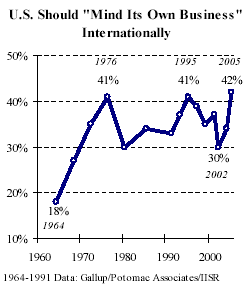
"We're seeing a backlash against a bumbled foreign policy." So said Stephen Van Evera of MIT in response to the news that Americans are becoming more isolationist in their views. I would have used the term "bungled"--or even "mangled"--to describe U.S. foreign policy at present, but "bumbled" (combining "bungled" and "stumbled") works well enough.

But I digress, even before getting started.

The New York Times reports today on a Pew Research Center study of elite and general public attitudes regarding foreign policy issues. Summarizing the report, the Times article states, "The survey, conducted this fall and released today, found a revival of isolationist feelings among the public similar to the sentiment that followed the Vietnam War in the 1970's and the end of the Cold War in the 1990's."

The following chart shows the change over the past forty years in the number of Americans saying the country should "mind its own business."

Among the additional findings of the study are these:

  • "Majorities in most groups of influentials say the U.S. should join the International Criminal Court. But military leaders are a notable exception--a narrow majority opposes the U.S. joining the international court."
  • "Favorable opinions of the United Nations, which had declined in recent years, have fallen still further. Only about half of Americans (48%) now express a positive opinion of the U.N., down from 77% four years ago."
  • "As to public perceptions of the U.S. global image, two-thirds of Americans (66%) say that the U.S. is less respected than in the past. When asked about possible reasons for global discontent with the U.S., overwhelming percentages of Americans (71%) and opinion leaders (87%) cite the war in Iraq as a major factor."
  • "The public, on balance, believes cases of U.S. prisoner mistreatment in Iraq and Guantanamo Bay were mostly the result of misconduct by American soldiers rather than the consequence of official policies. Opinion leaders are divided, with solid majorities in five of eight groups saying that the prison abuse scandal was the result of official policies."

Each of these points deserves some analysis and commentary, which I hope to provide when I have a bit more time--in a year or two. Meanwhile, take a look at the report.

Wednesday, November 16, 2005

Senator Hagel on Dissent

Yesterday, Senator Chuck Hagel (R-NE) gave a speech at the Council on Foreign Relations in Washington, D.C. on "U.S. Foreign Policy and the Middle East." While the entire speech is well worth reading, I want to highlight a brief passage that deals with criticism of the Bush Administration's policy in Iraq. Coming from a conservative senator from the President's own party, it strikes me as a particularly important statement.

The Bush Administration must understand that each American has a right to question our policies in Iraq and should not be demonized for disagreeing with them. Suggesting that to challenge or criticize policy is undermining and hurting our troops is not democracy nor what this country has stood for, for over 200 years. The Democrats have an obligation to challenge in a serious and responsible manner, offering solutions and alternatives to the Administration's policies.

Vietnam was a national tragedy partly because Members of Congress failed their country, remained silent and lacked the courage to challenge the Administrations in power until it was too late. Some of us who went through that nightmare have an obligation to the 58,000 Americans who died in Vietnam to not let that happen again. To question your government is not unpatriotic--to not question your government is unpatriotic. America owes its men and women in uniform a policy worthy of their sacrifices.

"To question your government is not unpatriotic."

Don't forget it.

Spreading Like Cancer

The New York Times reports today on new allegations of torture in Iraq, perpetrated this time not by Americans but by some of those we helped bring to power.

Iraq's government said Tuesday that it had ordered an urgent investigation of allegations that many of the 173 detainees American troops discovered over the weekend in the basement of an Interior Ministry building in a Baghdad suburb had been tortured by their Iraqi captors. A senior Iraqi official who visited the detainees said two appeared paralyzed and others had some of the skin peeled off their bodies by their abusers.

U.S. officials issued a disingenuous response:

A joint statement by the American Embassy and the United States military ommand called the situation "totally unacceptable" and said American officials "agree with Iraq's leaders that mistreatment of detainees will not be tolerated."

The American statement apparently omitted the words "by anyone other than us."

Tuesday, November 15, 2005

The Polls: Americans on Torture

It appears that a majority of Americans are consequentialists when it comes to torture. Recent poll results on the subject are located here. (Scroll down just past the CNN/USA Today/Gallup Poll questions.)

"Wondering If It Could Be Real"

Sherzad Khalid, an Iraqi businessman who was subjected to abuse by his American captors in July 2003, said, "I was wondering if it could be real that the American army was acting this way." His friend, Thahe Sabber, also captured and abused by American troops, said, "They just wanted to humiliate us in any shape or form they could. . . . I wish I knew why. I was sure, however, that their actions were not the same as the values and morals of the American people."

Read their story--and Jeanne's thoughtful take on it--at Body and Soul.

Monday, November 14, 2005

Something for Yoo to Think About

Philippe Sands, who spoke at Pepperdine's School of Law two weeks ago, published a piece in yesterday's San Francisco Chronicle that warns John Yoo, David Addington, and others who have offered bad legal advice regarding torture about the risks of traveling to countries that take the Convention Against Torture more seriously than the Bush Administration does. It is well worth reading.

The alternative to participation in the International Criminal Court may not be the impunity for Americans sought by the Bush Administration; it may instead be justice in the courts of other countries.

Why Habeas Corpus Matters

This, from today's Washington Post, is essential reading.

Saturday, November 12, 2005

IR Theory and Terrorism

The field of International Relations takes a hit from Kevin Drum at Washington Monthly. He quotes Abu Aardvark's contention that IR scholars have given surprisingly little attention to terrorism since 9/11. I confess that I don't devote large chunks of time to terrorism in my introductory IR course, but much of what I cover relates to the conditions under which transnational terrorism thrives. Discussions of failed states, transnational criminal organizations, ethnic conflict and intrastate war, and (during a recent discussion of international ethics) the problem of "blowback" all terrorism or the conditions conducive to its use. Still, I think that Abu Aardvark's focus on six particularly theoretical journals may suggest an idealized notion of how theory develops. That, however, is a long and boring topic that I will avoid for now.

Take a look at Kevin Drum's post, the Abu Aardvark post that inspired it, and then (if you're really interested in this topic) you can read my comment, which I'll cut and paste below to save you from having to scroll through the hundreds of comments that Kevin Drum gets.

I'm jumping into this conversation very late, but with both cheers and jeers for IR (since I teach the subject). First, IR has indeed been very state-centered since it got its start as a separate, identifiable discipline in the aftermath of World War I. (Incidentally, ever since Jeremy Bentham's comments about international law, the term international has been used to mean interstate. Likewise, the phrase "national security" has almost invariably meant "state security.") During the Cold War, state-centered analyses dominated--arguably for good reason since the big threat was a war like most of the other wars since 1648, only with nuclear weapons thrown into the mix. But, for many of us in the discipline, our failure prior to 1990 to see much beyond states (and the system they operate within) is a source of embarrassment.

The Vietnam War (and a host of other intrastate conflicts) helped some in the discipline to understand that there were important things happening in the shadows beyond the spotlight shining on U.S.-Soviet relations. But only with the end of the Cold War were IR theorists compelled to begin looking seriously at non-state actors. Curiously, some of the traditionalists argued that the post-Cold War focus on non-state actors was more about trying to preserve some relevance (and some jobs) than about a sincere effort to rethink the discipline.

Today, within the sub-field of security studies (to take a particularly relevant case), there are scholars writing about disease and security (and not just since the discoveries of SARS and avian influenza), transnational criminal organizations and security ("drugs and thugs"), environmental problems and security, and, of course, religious fanaticism and security. (Shameless self-promotion, but all of this is surveyed in a book being published next month entitled Seeking Security in an Insecure World.) Scholars generally recognize today that a lot of the most important stuff happening in the world today--both for good and for ill--has very little to do with the foreign and defense ministries of the world's great powers. And that recognition existed well before 9/11.

Those who didn't recognize the rising importance of non-state actors were, in many cases, committed ideologically to traditional ways of viewing international politics. Consider Richard Perle's words in the immediate aftermath of the 9/11 attacks: "This could not have been done without help of one or more governments. . . . Someone taught these suicide bombers how to fly large airplanes. I don't think that can be done without the assistance of large governments. You don't walk in off the street and learn how to fly a Boeing 767." (WaPo, 9/12/01)

Having said all of this, it is fair to ask whether IR can retain any coherence as a discipline if it moves from the study of politics among nations (to use the title of Hans Morgenthau's seminal work) to politics among nations, terrorist organizations, drug traffickers, pirates (they're making a comeback in the Indian Ocean), NGOs, international organizations, multinational corporations, influential persons from the pope to Bono, and who knows what else. Some of what those of us in IR are criticized for not knowing probably belongs in comparative politics or sociology or public health or any of a dozen other disciplines. But most of us wish we knew that stuff anyway. And the best students of IR do seem to know a lot about everything.

Friday, November 11, 2005

In Flanders Fields

Veterans' Day. . . . Armistice Day. . . . Remembrance Day.

By whatever name it goes from country to country, today is an appropriate time to post what was almost certainly the most popular poem to come out of the First World War. Lieutenant Colonel John McCrae, a Canadian doctor who served the British Empire in both the Boer War and World War I, published "In Flanders Fields" in December 1915. The poem memorializes those who died fighting in the Second Battle of Ypres of April 1915, a battle in which Germany used chlorine gas with deadly effect.

Soon after it appeared, the poem was used on military recruiting posters and in war bond campaigns. Later, after it had become apparent just how costly the Great War had been, "In Flanders Fields" would be read as an anti-war anthem.

McCrae himself died before the war was over, on January 28, 1918. As with so many other casualties of the war, it was disease, not gas or gunshot or shrapnel, that killed him. Dr. McCrae died from complications of pneumonia and meningitis.

In Flanders Fields
John McCrae

In Flanders Fields the poppies blow
Between the crosses, row on row,
That mark our place; and in the sky
The larks, still bravely singing, fly
Scarce heard amid the guns below.

We are the Dead. Short days ago
We lived, felt dawn, saw sunset glow,
Loved, and were loved, and now we lie
In Flanders fields.

Take up our quarrel with the foe:
To you from failing hands we throw
The torch, be yours to hold it high.
If ye break faith with us who die
We shall not sleep, though poppies grow
In Flanders fields.

Armistice Day

It is now known as "Veterans' Day" in the United States, but originally November 11th was "Armistice Day." It marked the end of the Great War, or what, with the benefit of tragic hindsight, came to be called the First World War.

On April 6, 1917, the United States entered a European war that had long been stalemated along the Western Front. In the Senate, the vote for war was 82-6; in the House, 373-50.

At first, the American contribution was limited primarily to naval forces and war materiel. Before military conscription began in the summer of 1917, the United States' Army, with only 130,000 men, was smaller than Belgium's. Before the war ended, however, the United States would have 4.8 million men under arms.

It was not only the American military contribution that turned the tide in the war. On January 8, 1918, President Wilson announced his Fourteen Points, a set of war aims designed to convince the German people, if not their stubborn leadership, that peace might be more palatable than a continuation of the war and its privations. That the Fourteen Points were generally acceptable to Germany was demonstrated by a "prearmistice agreement" under which the Germans, the Allies, and the Americans all agreed to make the Fourteen Points the foundation for the ultimate peace agreement.

On September 29, 1918, General Ludendorff informed the German government that Germany's military situation in northern France had become untenable. The German government communicated its desire for peace to President Wilson, but Wilson insisted that he would only negotiate with a democratic Germany. When his military withdrew its support, Kaiser Wilhelm was forced to abdicate the throne and Wilson's condition for a democratic negotiating partner was satisfied. Meanwhile, to pressure the Allies to make peace on the basis of the Fourteen Points, Colonel House hinted that the United States might negotiate a separate peace with Germany. With modest reservations regarding the Fourteen Points, the Allies agreed to accept Germany's overtures for peace.

On November 8, Germany sent its representatives to northern France. There, in the Compiegne Forest aboard Marshal Foch's railroad car, an armistice was signed at 5:00 a.m. on November 11. It took effect six hours later.

The guns fell silent along the Western Front on the eleventh hour of the eleventh day of the eleventh month in 1918.

Tuesday, November 08, 2005

Deterring Pirate Attacks

According to several news sources (including USA Today), the sonic weapon used by the Seabourn Spirit to deter the Somali pirates who attacked the cruise ship in the Indian Ocean on Saturday was a long-range acoustic device (LRAD) originally developed for the U.S. Navy by American Technology Corporation of San Diego. The non-lethal weapon was designed to deter attacks on ships like the bombing of the USS Cole in 2000, an attack that was carried out in a Yemeni port by suicide bombers who approached the Cole in a small boat packed with explosives.

LRAD permits broadcasting of messages or sounds (including ear-splitting noises) over long distances. Its use can cause permanent hearing loss at distances of up to 100 yards.

At present, the device is deployed on U.S. Navy ships operating in the Persian Gulf and as part of the force protection kits of the 1st Marine Expeditionary Force in Iraq. A number of cruise ships also carry the LRAD, which, because the sound it generates is focused in a particular direction, can be used without harming its operators or others not directly in the path of the sonic pulse.

Monday, November 07, 2005

"We Do Not Torture"

That, at least, is what President Bush said today. But consider some of the reactions his statement provoked:

The CNN story on Bush's remarks followed that line with these words:

Over White House opposition, the Senate has passed legislation banning torture. With Vice President Dick Cheney as the point man, the administration is seeking an exemption for the CIA. It was recently disclosed that the spy agency maintains a network of prisons in eastern Europe and Asia, where it holds terrorist suspects.

The BBC story reporting the comment also noted the following:

The White House has not confirmed Washington Post claims that the CIA set up a covert prison network in eastern Europe and Asia to hold high-profile terror suspects following the 11 September 2001 attacks.

About 30 detainees, considered major terrorism suspects, were held at these "black sites", although the centres have now been closed, the paper reported.

On Sunday, the United Nations' special rapporteur on torture urged European officials to conduct high-level investigations into the allegations.

USA Today stated:

U.S. interrogation practices have been under fire since news accounts in 2004 reported harsh tactics by U.S. interrogators at Abu Ghraib prison in Iraq, Guantanamo Bay in Cuba and at detention facilities in Afghanistan. In a new case Monday, five Army Rangers were charged with abusing detainees in Iraq.

Over White House opposition, the Senate voted 90-9 last month to approve an amendment by Sen. John McCain, R-Ariz., that would ban the use of torture. Vice President Cheney has pushed for an exemption for the CIA.

That the news media now seem to be inclined to report a few facts along with the President's outrageous assertions is an encouraging sign. Equally encouraging is that fact that both liberal and conservative bloggers (below) are expressing outrage over statements like the President's.

Kevin Drum wrote:

Fine. Then shut down the black sites, tell Dick Cheney to stop lobbying against the McCain amendment, and allow the Red Cross unfettered access to prisoners in our custody. After all, if the events of the past four years had happened in any other country in the world--the abuse, the memos, the photos, the relentless opposition to independent inspections--isn't that the least it would take for any of us to believe it when that country's head of state declared "We do not torture"?

Andrew Sullivan said,

If that's the case, why threaten to veto a law that would simply codify what Bush alleges is already the current policy? If "we do not torture," how to account for the hundreds and hundreds of cases of abuse and torture by U.S. troops, documented by the government itself? If "we do not torture," why the memos that expanded exponentially the lee-way given to the military to abuse detainees in order to get intelligence? The president's only defense against being a liar is that he is defining "torture" in such a way that no other reasonable person on the planet, apart from Bush's own torture apologists (and they are now down to one who will say so publicly), would agree. The press must now ask the president: does he regard the repeated, forcible near-drowning of detainees to be torture? Does he believe that tying naked detainees up and leaving them outside all night to die of hypothermia is "torture"? Does he believe that beating the legs of a detainee until they are pulp and he dies is torture? Does he believe that beating detainees till they die is torture? Does he believe that using someone's religious faith against them in interrogations is "cruel, inhumane and degrading" treatment and thereby illegal? What is his definition of torture?

"And Now for Something Completely Different"

(As they used to say on Monty Python's Flying Circus.) Actually, it's not completely different. It's still all about the piracy thing. But the presentation is different.

Go here to take a look.

Some Data on Piracy

As you can probably tell, the recent account of pirates attacking a cruise ship off the coast of Somalia has captured my imagination. It's not because of some latent fascination with Blackbeard or Captain Hook. It has more to do with my concern that the spread of anarchy--from failed states to the high seas--has become a major source of insecurity in the world. Attacks on cruise ships (as well as cargo ships and fishing boats) are a manifestation of the problem.

At the risk of spending too much time and energy on what some may consider a back-page story, I want to pass along a bit of data on the incidence of piracy in the world. The following information comes from the International Maritime Bureau Piracy Reporting Centre, which collects data on piracy and armed robery aboard ships.

The total number of attacks on shipping dropped from 445 in 2003 to 325 in 2004. The greatest number of pirate attacks occur in the waters off Indonesia (including the Strait of Malacca, the Java Sea, and the Timor Sea); there were 121 attacks there in 2003, 93 in 2004. Rebels from Aceh have been known to hijack ships in the Northern Malacca Straits, but many recent hijackings have been the work of criminal syndicates.

While most acts of piracy are property crimes only, in 2004 there were 30 crew members murdered in attacks on shipping.

For maps showing the locations of reported acts of piracy in 2004, go here.

Sunday, November 06, 2005

Illusions of Righteousness

"No nation, ours or any other, is well served by illusions of righteousness. All nations make decisions based on self-interest and then defend them in the name of morality."

--William Sloane Coffin

More on the Indian Ocean Pirates

The attack on a luxury cruise ship off the coast of Somalia yesterday was not the only act of piracy in those waters in recent months. The Russian newspaper Pravda reported two weeks ago that an International Maritime Bureau report documented twenty-three attacks in the area since March 15, 2005. One of the attacks resulted in the Hong Kong-based owner of a liquefied gas tanker paying hijackers $315,000 for the return of the ship after it was seized on April 10, 2005. In another attack on August 15, 2005, three fishing boats and forty-eight Asian fishermen were captured by Somali pirates. All are being held for ransom in Somalia.

According to Pravda, those engaged in piracy off the coast of Somalia are Somali rebels who use the proceeds of their raids to buy weapons.

Cheney's Defense of Torture

Kevin Drum at Washington Monthly makes some important points regarding Vice President Cheney's efforts to preserve the freedom to torture detainees in the "war on terror." He also points these comments from Andrew Sullivan concerning Cheney:

He's still furiously lobbying Senators to protect his right to torture. A man who avoided service in Vietnam is lecturing John McCain on the legitimacy of torturing military detainees. But notice he won't even make his argument before Senate aides, let alone the public. Why not? If he really believes that the U.S. has not condoned torture but wants to reserve it for exceptional cases, why not make his argument in the full light of day? You know: where democratically elected politicians operate.

As Drum concludes, "It's enough to make any decent human being puke."

That's about right.

Saturday, November 05, 2005

Pirate Attack

Tomorrow's Observer reports that a luxury cruise liner sailing approximately 100 miles off the coast of Somalia in the Indian Ocean came under attack from pirates today. Men on two speedboats fired on the ship, the Seabourn Spirit, with machine guns and rocket-propelled grenades. The ship escaped from the two speedboats after attempting to ram one of them. One crew member suffered minor injuries from shrapnel. None of the 151 passengers was injured.

The McCain Amendment: An Update

Jeanne at Body and Soul offers a good, brief summary of where things stand regarding the McCain Amendment.

Our East European Gulag

Rosa Brooks, writing in today's Los Angeles Times, recounts the news from a Washington Post story published earlier this week about the CIA's use of secret detention facilities in Eastern Europe and questions whether America's values, which served the nation well during the Cold War, have survived the "war on terror." She writes,

During the Cold War, we thought we knew what distinguished us from our Soviet bloc enemies. We did not have a gulag; we did not imprison and torture our enemies. But the war on terror has distorted our national values. We have used some of the same tactics we once decried. The Soviet Union's legacy of terror lives on, its tactics embraced by some of our leaders. Vice President Dick Cheney continues to insist that the McCain amendment, which prohibits U.S. personnel from cruel, inhumane and degrading treatment of prisoners, should not be applicable to the CIA.

We Americans have always had an inflated view of our nation's moral righteousness, but rarely has the gap been so dramatic between who we believe ourselves to be and who our actions show us to be in reality.

Friday, November 04, 2005

Reciprocity

Milt Bearden, a former CIA operative, uses his experience working with the mujahidin during the Soviet occupation of Afghanistan to explain why the United States ought to be extending the protections of the Geneva Conventions even to those detainees who are considered enemy combatants. It boils down to a concern for reciprocity, as this op-ed in today's New York Times notes.

Thursday, November 03, 2005

More on Maher Arar

This post from February of this year describes the plight of Maher Arar, a Canadian citizen who was taken into custody by U.S. officials at New York City's Kennedy International Airport in September 2002 and then rendered by the United States to Syria. When he was released a year later--without ever having been charged with a crime--Arar claimed that he had been tortured while in a Syrian prison. According to a report prepared by Stephen J. Toope, former dean of the McGill University School of Law, Arar and other Canadian citizens who were rendered to Syria by the United States were unquestionably tortured while in Syrian custody. Regarding Mr. Arar, the report states, "Although there have been few lasting physical effects, Mr. Arar's psychological state was seriously damaged and he remains fragile. His relationships with members of his immediate family have been significantly impaired. Economically, the family has been devastated."

Meanwhile, the United States Congress is still unwilling to condemn torture unequivocally, although in fairness it appears that an increasing number of Republicans in the House of Representatives are now willing to vote for the McCain Amendment to the defense appropriations bill.

[Via Body and Soul.]

Wednesday, November 02, 2005

Remembering the Holocaust

The UN General Assembly adopted a resolution (A/RES/60/7) yesterday that designates January 27 as an annual day of remembrance for victims of the Nazi Holocaust. The date chosen is the anniversary of the liberation of Auschwitz in 1945 and is already observed in much of Europe (and occasionally at Pepperdine) as the Day of Remembrance.

The resolution, which was introduced by Australia, Canada, Israel, Russia, and the United States, had 104 cosponsors and was adopted by consensus. According to Israel's ambassador to the UN, Dan Gillerman, this is the first resolution initiated by Israel to have been passed by the UNGA.

A Shift in the Wind?

"The Bush administration is embroiled in a sharp internal debate over whether a new set of Defense Department standards for handling terror suspects should adopt language from the Geneva Conventions prohibiting 'cruel,' 'humiliating' and 'degrading' treatment," according to a story in today's New York Times. Although those surrounding Vice President Dick Cheney, including David Addington who was appointed to be Cheney's chief of staff in the wake of Scooter Libby's indictment, continue to resist efforts to curb the administration's use of torture against terrorism suspects, a significant pushback seems at last to be occurring.

The Bush administration has been unwilling to listen even to friendly critics of its policies in the so-called "war on terrorism," but domestic and international pressure to renounce torture may at last be having an impact. At least those interested in adhering to international law and morality are finally able to debate the treatment of detainees.

Names and Faces

The number 2,000 was in the news last week, but it is important that we not forget the human beings behind the number. The New York Times has an excellent interactive site with photos and brief biographies of the 2,000-plus American soldiers who have died in Iraq since the beginning of the war in March 2003. Take a look and think of the costs of war.

Tuesday, November 01, 2005

Trick or Treat

I am a day late with this, but James Carroll's columns are always timely. Here, quoting St. Paul and Robert McNamara along the way, he moves from Halloween to the nature of evil to wars and their unintended consequences. Read what he has to say.