Monday, January 22, 2007

Children in China

Beth Nonte Russell describes some of the effects of China's one-child policy in an op-ed in tomorrow's New York Times. As economist Amartya Sen first noted over a decade ago, one of the effects is a large number--60 million by 2010--of "missing" girls. Russell writes,

And what happened to these girls? According to the International Planned Parenthood Federation (a term that takes on a whole new meaning when referring to China), there are about seven million abortions in China per year, 70 percent of which are estimated to be of females. That adds up to around five million per year, or 50 million by the end of the decade; so where are the other 10 million girls? If even 10 percent end up in orphanages . . . well, you do the math.

Although many girls in China end up in orphanages, the U.S. Department of State reports that Americans adopted only 6,493 Chinese children last year, down from 7,906 the year before.

Why aren't there more adoptions? Russell blames new Chinese government policies designed to make adoption difficult.

Under the new Chinese adoption guidelines, the international adoption celebrity Angelina Jolie could not adopt from China (she’s not married, and alas, she and Brad have more than two divorces between them, which is a no-no); nor could the actress Meg Ryan (again, not married). Another person who is not eligible is yours truly. My husband is over 50, so I would have to trade him in, marry again, wait the required five years (another new rule) before beginning the adoption process, and by that time I would be sneaking up on 50 myself.

It is comforting to know that Madonna is still eligible, at least until she turns 50, gets fat (the new regulations call for a body mass index of less than 40), gets divorced or goes broke (anyone with a net worth of under $80,000 is excluded).

Meanwhile, Chinese authorities are predicting "confusion in the social order" as more and more young males face the reality that there are simply not enough women to meet the demand in the marriage market.
Wednesday, January 17, 2007

More on Malibu's Dictator-in-Residence

This week's issue of LA Weekly, which hits the streets tomorrow, has an excellent story on the purchase of a $35 million estate in Malibu by the son of Equatorial Guinea's dictator. Diana Ljungaeus has dug much more deeply into the story than either Melissa Giaimo or I did back in November. (Ms. Giaimo wrote a very interesting front-page story for Pepperdine's newspaper, The Graphic, and I made some observations in a post titled "Welcome to the Neighborhood.") In addition to providing new details about the purchase and about the Obiang family, Ljungaeus's story discusses the failure of Malibuites, who are ordinarily quick to become involved in important political issues, to express any opinions about the dictator (or, to be more precise, the dictator-in-waiting) living just down the street.

In the interest of full disclosure--and to entice some of you to actually click on the link or pick up a copy of LA Weekly--I should point out that I'm quoted in the story. There's more: A photograph--of me. (Thank you, Diana Ljungaeus and Rena Kosnett.)

Freedom Stagnation

Freedom in the World 2007, the new edition of the annual report by Freedom House, was released today. The press release accompanying the report notes that the survey "found that the percentage of countries designated as Free has remained flat for nearly a decade and suggests that a 'freedom stagnation' may be developing."

Among its more specific findings, the survey indicates that

the number of countries judged by Freedom in the World as Free in 2006 stood at 90, representing 47 percent of the global population. Fifty-eight countries qualified as Partly Free, with 30 percent of the world’s population. The survey finds that 45 countries are Not Free, representing 23 percent of the world’s inhabitants. About one-half of those living in Not Free conditions inhabit one country: China.

Freedom in the World 2007 also states that in 2006 there were 123 electoral democracies in the world, the same number as the year before.

Tuesday, January 16, 2007

Civil Rights and Human Rights

The Allies' triumph over Fascism in World War II was, in large measure, a victory over claims of racial superiority or inferiority. Oppressed peoples everywhere took note and began to press claims for freedom and equality.

Those who organized the postwar international order paid attention to these claims. The Charter of the United Nations listed among the purposes of the organization fostering international cooperation "in promoting and encouraging respect for human rights and for fundamental freedoms for all without distinction as to race, sex, language, or religion" (Art. 1). Racial equality was clearly an idea whose time had come, but America's war against German and Japanese racism was fought not by blacks and whites standing shoulder to shoulder but by black units and white units, separate and unequal even as they fought a war against racism.

Cognizant of the inconsistency between America's support for human rights abroad and its segregationist policies at home, President Truman in 1946 appointed a Committee on Civil Rights to offer a way forward for the United States. A report issued by the Committee in 1948 noted the problems inherent in trying to exert moral leadership in the world while failing to address civil rights problems in the United States:

Our position in the post-war world is so vital to the future that our smallest actions have far-reaching effects. . . . We cannot escape the fact that our civil rights record has been an issue in world politics. The world’s press and radio are full of it. . . . Those with competing philosophies have stressed--and are shamelessly distorting--our shortcomings. . . . They have tried to prove our democracy an empty fraud, and our nation a consistent oppressor of underprivileged people. This may seem ludicrous to Americans, but it is sufficiently important to worry our friends. The United States is not so strong, the final triumph of the democratic ideal is not so inevitable that we can ignore what the world thinks of us or our record.

Truman issued an executive order calling for the integration of the United States military, a small first step. At the United Nations, Eleanor Roosevelt brought the work of the UN Commission on Human Rights to a successful conclusion in the matter of the Universal Declaration of Human Rights. It was approved, without dissent, by the General Assembly on December 10, 1948. The UDHR declared, in Article 2, that "everyone is entitled to all the rights and freedoms set forth in this Declaration without distinction of any kind, such as race, color, sex, language, religion, political or other opinion, national or social origin, property, birth or other status."

These were small steps, but to those opposed to civil rights they served as a call to arms. In the aftermath of Truman's reliance on the UN Charter rather than a congressional declaration of war as the legal authority for military intervention in Korea, both isolationists and segregationists (two groups with considerable overlapping membership) rallied around the Bricker Amendment, which (in various guises) was intended to prevent the president's treaty-making power from being used to alter the fundamental norms of the American constitutional system, including the nature of the relationship between states and the federal government. In essence, isolationists supported the Bricker Amendment in order to prevent the United States from becoming further involved in multilateral institutions and segregationists supported it in order to prevent international human rights law from advancing the civil rights movement. To block the Bricker Amendment in the Senate, President Eisenhower was forced to end U.S. involvement in negotiations toward an International Bill of Human Rights.

In essence, opposition to civil rights in the Senate had the ancillary effect of ending American leadership of the international human rights movement. To this day, the United States has still not recovered its position of leadership where human rights are concerned.

Monday, January 15, 2007

Addressing the MANPADS Threat

The threat to civil aviation from small shoulder-fired anti-aircraft missiles, or MANPADS (man-portable air defense systems) has long been a source of concern. (I commented on it here in November 2004.) At Los Angeles International Airport today, Northrop Grumman unveiled a defensive system called "Guardian" that critics contend is too expensive to be affordable to the struggling airline industry and wrong-headed in its approach.

The system, mounted on a FedEx MD-10 cargo plane for an eighteen-month trial, employs directed infrared countermeasures (DIRCM) designed to disable the tracking mechanisms of anti-aircraft missiles. Originally developed for the military, the technology has been adapted by Northrop Grumman for use on commercial airplanes.

In addition to the cost of deploying the system (roughly $11 billion across the industry according to a study conducted by Rand in 2005), critics argue that Guardian represents a deviation from what ought to be the primary focus on surveillance. John Meenan, the executive director of the Air Transport Association, put it this way: "Isn't a surveillance program around airports better? Shouldn't we be doing more to go after the archer rather than trying to catch the arrows?" Meenan noted that there are other threats to commercial aviation such as rocket-propelled grenades that would not be addressed by the Guardian system.

The U.S. military currently uses a system called "Nemesis," based on the same technology as the Guardian system, on a variety of fixed-wing and rotary aircraft.

"Creatively Maladjusted"

Human salvation lies in the hands of the creatively maladjusted.

--Dr. Martin Luther King, Jr.

[Via SojoMail (from Sojourners).]

Sunday, January 14, 2007

Growing a Little Wiser

Take three minutes and listen to this commentary by conservative columnist Rod Dreher of the Dallas Morning News.

[Via Matthew Gross, who provides text (and a broken link).]

Friday, January 12, 2007

On to Iran?

On Wednesday evening shortly after the President's speech, a professor and keen observer of military affairs (sometimes the two are not mutually exclusive) from another university e-mailed to say, "You heard it here first. . . . Watch in coming weeks for 'disrupting networks' in Iran to be (very thin) cover for initiating hostilities against Iran, rather like 'disrupting sanctuaries' was in Cambodia." Now, from today's Boston Globe, there's this:

Secretary of State Condoleezza Rice refused yesterday to rule out cross-border US military action against Iran, a day after President Bush pledged in a major speech to "seek out and destroy" Iranian and Syrian networks providing weapons and training to anti-American forces in Iraq.

My colleague is not the only one worried about the Cambodia precedent, according to the Globe story:

Senator Chuck Hagel, a Nebraska Republican, compared the idea of pursuing Iranian networks to the secret 1970 expansion of the Vietnam War into Cambodia.

"Some of us remember 1970, Madame Secretary, and that was Cambodia, and when our government lied to the American people and said we didn't cross the border going into Cambodia. In fact we did," he said. "So, Madame Secretary, when you set in motion the kind of policy that the president is talking about here, it's very, very dangerous."

It's time for the checks and balances in our constitutional system to start working.

Thursday, January 11, 2007

Terrorists on Your Desk

Does your 2007 desk calendar have photos of terrorists wanted by the United States Government? If not, you obviously don't have Counterterrorism 2007, a desk calendar published by the National Counterterrorism Center. But, not to worry. You can download the calendar here in this 15 MB .pdf file.

A Voice from Guantanamo

The Los Angeles Times today published excerpts of letters from Jumah al-Dossari, who has been imprisoned in Guantanamo since 2002. He describes being subjected to sleep deprivation, loud music, extreme cold, and threats to the life of his daughter.

In one letter, al-Dossari wrote,

If I die, please remember that there was a human being named Jumah at Guantanamo whose beliefs, dignity and humanity were abused. Please remember that there are hundreds of detainees at Guantanamo suffering the same misfortune. They have not been charged with any crimes. They have not been accused of taking any action against the United States.

Today marks the fifth anniversary of the arrival of the first detainees at Guantanamo. It is a day that has been marked by protests all over the world.

The Good Shepherd

The Good Shepherd, which tells the story of the CIA from its origins in the early days of World War II (as the OSS) to the Bay of Pigs invasion, opened while I was in Europe and so I don't know much about the initial critical response. But because Eric Roth, who wrote the screenplay, has been telling me about the film for well over a year, I went to see it as soon as I could after my return to the U.S.

First of all, The Good Shepherd is a very thoughtful--and thought-provoking--film that is well worth seeing. But don't expect to fall in love with any of the characters (even though they are played by a star-studded cast) and don't expect to leave the theater feeling good. The story is one of idealism surrendered and virtue corroded by the burdens of secrecy. It is, in fact, painful to witness Edward Wilson--the main character, played by Matt Damon--try to deal with the tension between the moral demands of his job with the Agency and his personal moral responsibilities.

It is an open question whether the tenuous ethical position that Wilson holds at the end of The Good Shepherd is a consequence of his own failings or an inevitable result of his circumstances, but in either case the outcome is very problematic for those who would like to believe that those who make foreign policy can be successful without selling their souls.

Wednesday, January 10, 2007

Back in Business

My travel break, running from December 13 to January 1, merged into a second break during which I've been trying to catch up on things left undone during the travel break. It is long past time, though, to return to the blog. So, to those of you who are regular readers, thanks for your patience. Now that I've broken the ice with this post, I expect to have something to say (or at least something to link) almost daily for the foreseeable future.

My travels, for those who might be curious, took me (and my parents and my sons) to Italy, France, Monaco, Andorra, Spain, and Portugal by car. The route took us (more or less) from Milan to Monte Carlo, Avignon, Andorra la Vella, Montserrat, Zaragoza, Bilbao, Santiago de Compostela, Porto, Lisbon, Madrid, Aix-en-Provence, Florence, and back to Milan. We covered over 6,000 kilometers in just over two weeks, but most of the driving was done in relatively short daily stretches of 300 kilometers or so. All in all, it was a great trip.

Incidentally, if you left a comment during my absence, it was held up by design. I've now published most of the comments that I found when I returned and will get to the others soon.

Wednesday, December 13, 2006

Holiday Break

I'll be taking a break from blogging in order to travel and unwind. Please stop back by around the first of the year.

Merry Christmas!

Monday, December 11, 2006

Ten Favorites

Before I take a break from blogging--and from just about everything else--for the holidays, I thought I might post a list of my favorite books from this past year. Just to be clear, not all of the books on this list were published in 2006. They just happened to be among the books I read over the course of the past twelve months.

  1. James Carroll, House of War
  2. George Packer, The Assassins' Gate: America in Iraq
  3. Kwame Anthony Appiah, Cosmopolitanism
  4. Chris Hedges, War Is a Force that Gives Us Meaning
  5. Moisés Naím, Illicit: How Smugglers, Traffickers, and Copycats are Hijacking the Global Economy
  6. Philippe Sands, Lawless World
  7. Karen Armstrong, The Battle for God: A History of Fundamentalism
  8. Ron Suskind, The One Percent Doctrine
  9. Richard T. Hughes, Myths America Lives By
  10. Stephen Walt, Taming American Power: The Global Response to U.S. Primacy

There's not a lot of pleasure reading on this list. Two books that ranked high in my "just for fun" category were a brief and very readable work by historian Paul Johnson, The Renaissance, and a trip back to Charlottesville via the words of Garry Wills, Mr. Jefferson's University.

I think I'll need to work a little more fiction into my reading diet in 2007.

Sunday, December 10, 2006

Parking and Corruption

The New York Times Magazine today published its "Ideas" issue--a fascinating compendium of studies and cultural observations from the past year. An interesting entry in this issue reviewed a study published during the summer by two economists, Raymond Fisman of Columbia and Edward Miguel of UC-Berkeley.

Fisman and Miguel decided to see if there was a correlation between the behavior of diplomats at the United Nations in New York and the level of corruption in the countries they represent. More specifically, they asked whether diplomats from countries ranking high on indices of official corruption were more likely to exploit their diplomatic immunity by parking illegally on New York's crowded streets. Here's an extended excerpt of the Magazine's summary:

The two scholars studied parking tickets that were racked up in Manhattan by diplomats from 146 countries who were posted to the United Nations. In a situation in which every diplomat essentially received an invitation to be corrupt, diplomats from nations with "clean" governments said, "No, thanks."

The study began with the observation that, until late 2002, there was essentially zero enforcement of parking rules where diplomats were concerned. Diplomats were ticketed, but few if any cars were towed, and no one demanded payment. Using public records stretching back to 1997, Fisman and Miguel identified which diplomats had delinquent tickets, and how many --150,000 in all, representing more than $18 million in fines.

If incentives trumped culture, you would suppose that diplomats from every nation would cheat. But in fact, attachés from Canada, Ireland, Scandinavian nations and Japan evidently drove around the block till they found a spot. (Diplomats with few or no unpaid tickets also tended to get few tickets, period.) The worst offenders, meanwhile, came from Kuwait (246 unpaid tickets per diplomat), Egypt, Chad, Sudan, Bulgaria, Mozambique, Albania, Angola and Senegal. This behavior correlated strongly with the scores of diplomats' home countries on a measure of public corruption compiled by World Bank researchers.

I'm hoping to conduct a similar study of the correlates of students who park illegally in the faculty lot at Pepperdine next semester.

Human Rights Day 2006

Augusto Pinochet has died--on Human Rights Day.

Pinochet, who ruled Chile for seventeen years after ousting democratically elected president Salvador Allende, voiced the aspirations of authoritarian dictators everywhere when he said, "Not a leaf moves in this country if I'm not moving it."

Saturday, December 09, 2006

Killer Smog

With smoke from brush fires clouding the skies over much of southeastern Australia, it's worth recalling the Great Smog of 1952. It was on December 9, 1952, that the Great Smog finally lifted in London. An educational site maintained by the Met Office in London states:

The smoke-laden fog that shrouded the capital from Friday 5 December to Tuesday 9 December 1952 brought premature death to thousands and inconvenience to millions. An estimated 4,000 people died because of it, and cattle at Smithfield, were, the press reported, asphyxiated. Road, rail and air transport were almost brought to a standstill and a performance at the Sadler's Wells Theatre had to be suspended when fog in the auditorium made conditions intolerable for the audience and performers.

The spike in deaths due to the Great Smog was noticed only three weeks later when official mortality figures were published. The awareness that several thousand people had died for reasons directly related to air pollution, however, made a difference in public policy. Eric Nagourney of the New York Times writes,

The Great Smog is considered a turning point in environmental history. Although there had been other episodes where air pollution was held responsible for a spike in deaths--notably in the Meuse Valley in Belgium in 1930, and in Donora, Pa., in 1948--the numbers were much lower than those in London. In the aftermath, British officials passed laws banning the emission of black smoke and requiring industry to switch to cleaner-burning fuels.

These laws gradually produced dramatic reductions in some of the more unhealthy components of London's famous fog.

Friday, December 08, 2006

Trouble in Iran

If Iran has a special prosecutor, he may be needed to investigate President Ahmadinejad soon. According to this story from the Guardian earlier this week, Ahmadinejad watched females dancing during the opening ceremonies of the Asian Games in Doha, Qatar last Friday. Conservative religious leaders in Iran are not happy.

Wednesday, December 06, 2006

Blood Diamonds

Blood Diamond, starring Leonardo DiCaprio, Jennifer Connelly, and Djimon Hounsou, opens on Friday. Pepperdine student Christina Tippitt, who has seen an advance screening, recommends the film enthusiastically.

Back on September 18, Amnesty International sponsored a National Day of Action on Conflict Diamonds during which AI members conducted surveys in 246 diamond retailers in eighteen states. Here are some of the results from that survey:

  • Only 27% of shops were able assure us that they had a policy on conflict diamonds.
  • 30% of the shops that said they had a policy were unable to produce a hard copy of or explain it.
  • Only 13% of shops provided warranties to their customers as a standard practice.
  • 37% of the shops we visited claimed to be aware of the conflict diamonds issue. But 54% of them reported an inaccurate definition of the crisis.
  • Only 28% of the shops were aware of the Kimberley Process.
  • 29% of those who were aware of the Kimberley Process had only a minimal or limited understanding of it.
  • When asked whether consumers inquired about conflict diamonds, 83% of respondents answered rarely or never.
  • 110 shops refused outright to take the survey.

If you have a chance to see the movie, come on back here and leave a comment about it.

Tuesday, December 05, 2006

Million Dollar Trials

According to the Miami Herald, the Pentagon has proposed diverting $75 to $125 million dollars in already appropriated military construction funds to Guantanamo for a courtroom complex where military commissions would conduct trials for 75 to 80 of the 430 or so remaining prisoners at the base. I could be wrong, but that appears to come to roughly $1 million per trial.

Even some Republican members of Congress are asking questions.

[Via Kevin Drum.]

Good Questions

Someone in the White House press corps raised some very good questions at yesterday's press briefing:

*****

Q I have a question about the Rumsfeld memo. At the time when he was saying to the President, in this memo, that things aren't working in Iraq, the President was saying two things publicly: One, that we're winning in Iraq, absolutely; and he was also lashing Democrats, saying that criticism was not a plan for Iraq, and that we -- the administration -- have a plan for victory in Iraq. So why wasn't the President leveling with the American people?

MR. SNOW: Actually, at the time that this came --

Q Why wasn't he saying publicly what top members of this administration who were running the war were saying privately?

MR. SNOW: Well, there are a couple of things. First, at that very time, he was actually saying, things are not getting well enough fast enough. That was a formulation he was using at the time. If you take a look at the Rumsfeld memo that was printed in The New York Times, what you end up having is what the President I think has made it clear that he wants, which are people thinking creatively and exhaustively about ways of getting better results in Iraq.

And this is not -- other than at the very beginning, he says, clearly U.S. forces -- it's not working well enough or fast enough, what they're doing. That is a phrase that the President had adopted and had been using. And I don't know whether it comes from Secretary Rumsfeld or from the President. And then you have a list of options.

So I don't think you've got a case where the President was saying one thing and advisors were saying another. What the President was saying is that you've got a sovereign government with the government of Prime Minister Maliki that is pursuing what it needs to pursue, but obviously needs to be doing so more effectively and more rapidly. And that would include security. It would include reconciliation. It would include economic measures. It would include things like the hydrocarbon law. So certainly we weren't trying to wrap it up into a neat little bundle, because it's a very complex situation.

Q But doesn't it strike you that at the same time that you and others in this administration were accusing the likes of John Murtha of cutting and running by suggesting redeployment of forces to the periphery of Iraq or to nearby Kuwait, that the Secretary of Defense is suggesting similar options?

MR. SNOW: What Mr. Murtha had suggested was -- he was never quite that specific, and I think I'd let him speak for himself, but I believe when he came on "Meet the Press," he was talking about redeploying to Okinawa. What you have in here is a description of possibly having forces --

Q But that's not the -- he talked about redeploying to Kuwait. You say you don't want to talk more, but you're not talking accurately.

MR. SNOW: No, here's what he says, is, "You can withdraw forces from vulnerable positions -- cities, patrolling, et cetera -- and move forces to a quick reaction force status operating from within Iraq and Kuwait." Now, it is one of many options that are described here. What it means is the administration is trying to take a look at every suggestion, as I think would be incumbent.

Q Wait a second. You're not really answering the question. You're trying to parse what Murtha's position was.

MR. SNOW: No, I'm not --

Q Wait a second, let me just finish.

MR. SNOW: Okay.

Q Isn't it striking that this administration was accusing the likes of John Murtha and other Democrats who suggested course correction, including phased withdrawal, of cutting and running --

MR. SNOW: No, let me --

Q -- at the same time that the Defense Secretary was suggesting just the same option?

MR. SNOW: No.

Q You don't see hypocrisy there?

MR. SNOW: No, because you're talking about apples and oranges. If you take a look at --

Q Really?

Hit the Road, John

John Bolton has finally resigned. And President Bush has finally accepted the fact that Bolton was never going to be confirmed by the Senate.

Commenting on Bolton's departure, Kofi Annan spoke, well, diplomatically: "As a representative of the U.S. government he pressed ahead with the instructions that he had been given, and tried to work as effectively as he could with the other ambassadors."

The faintest of praise.

For more, see the Bolton Watch, which just might be able to hang it up now.

Monday, December 04, 2006

Spying and Social Learning

Anyone interested in recent developments in intelligence-gathering (and, even more to the point, intelligence-sharing) must read this article by Clive Thompson published in the New York Times Magazine yesterday. While no brief excerpt can capture the full range of points made in the article, these paragraphs describing an idea presented by Calvin Andrus, chief technology officer of the CIA's Center for Mission Innovation, suggest one of the ways that social learning can be (and, in fact, has been) developed within the intelligence community:

Andrus argued that the real power of the Internet comes from the boom in self-publishing: everyday people surging online to impart their thoughts and views. He was particularly intrigued by Wikipedia, the "reader-authored" encyclopedia, where anyone can edit an entry or create a new one without seeking permission from Wikipedia's owners. This open-door policy, as Andrus noted, allows Wikipedia to cover new subjects quickly. The day of the London terrorist bombings, Andrus visited Wikipedia and noticed that barely minutes after the attacks, someone had posted a page describing them. Over the next hour, other contributors--some physically in London, with access to on-the-spot details--began adding more information and correcting inaccurate news reports. "You could just sit there and hit refresh, refresh, refresh, and get a sort of ticker-tape experience," Andrus told me. What most impressed Andrus was Wikipedia's self-governing nature. No central editor decreed what subjects would be covered. Individuals simply wrote pages on subjects that interested them--and then like-minded readers would add new facts or fix errors. Blogs, Andrus noted, had the same effect: they leveraged the wisdom of the crowd. When a blogger finds an interesting tidbit of news, he posts a link to it, along with a bit of commentary. Then other bloggers find that link and, if they agree it's an interesting news item, post their own links pointing to it. This produces a cascade effect. Whatever the first blogger pointed toward can quickly amass so many links pointing in its direction that it rockets to worldwide notoriety in a matter of hours.

Spies, Andrus theorized, could take advantage of these rapid, self-organizing effects. If analysts and agents were encouraged to post personal blogs and wikis on Intelink--linking to their favorite analyst reports or the news bulletins they considered important--then mob intelligence would take over. In the traditional cold-war spy bureaucracy, an analyst's report lived or died by the whims of the hierarchy. If he was in the right place on the totem pole, his report on Soviet missiles could be pushed up higher; if a supervisor chose to ignore it, the report essentially vanished. Blogs and wikis, in contrast, work democratically. Pieces of intel would receive attention merely because other analysts found them interesting. This grass-roots process, Andrus argued, suited the modern intelligence challenge of sifting through thousands of disparate clues: if a fact or observation struck a chord with enough analysts, it would snowball into popularity, no matter what their supervisors thought.

There's much more in the article, including an extensive discussion of some of the problems that wiki- and blog-related information-sharing pose in an organization in which the need to share information (in order to "connect the dots" when trying to unravel complex plots) must be balanced against the need to keep secrets.

Sunday, December 03, 2006

Litvinenko

Today's New York Times traces the strange saga of Russian dissident Alexander Litvinenko from his investigation of a 1994 attempt on the life of Boris Berezovsky to his death by radiation poisoning last week in a London hospital. It's the stuff of spy novels and TV movies.

Friday, December 01, 2006

Port Calls in Mongolia

Most of the world's dry land would have to be covered by rising seas before Mongolia could come close to having an ocean port. (The country's lowest altitude is 532 meters above sea level.) But Mongolia's position astride some of the world's highest mountains is no barrier to registering ships.

Since 2004, the Mongolian flag has been numbered among the world's flags of convenience for ship owners. There's even a photo of a ship with Mongolian registry at Coming Anarchy.

World AIDS Day, 2006

Today is World AIDS Day. To learn a little about the history of AIDS and about its impact in the world, take a look at this interactive feature on the website of the Toronto Globe and Mail.

Thursday, November 30, 2006

The Bard on Iraq

Shakespeare penned a lot of famous lines, but none is more famous than this one from Romeo and Juliet: "What's in a name? that which we call a rose / By any other name would smell as sweet . . ."

Because no one is coming out of Iraq smelling like a rose, a naming controversy has erupted over the conflict there.

On Sunday, the New York Times carried a story that asked whether Iraq's circumstances fit the academic definition of "civil war." The consensus was that there is in fact a civil war going on in Iraq.

This week, numerous media outlets began using the term "civil war," some with considerable fanfare. President Bush, however, remained unmoved. Yesterday, in fact, a headline in the New York Times read, "Bush Declines to Call Situation in Iraq Civil War."

On Monday, the Borowitz Report detailed the president's latest plan to deal with the situation:

President George W. Bush said today that he would not allow a civil war in Iraq to erupt on his watch, and said that in order to prevent that from happening the United States would aggressively search for new synonyms for the phrase "civil war."

In order to seek out the most sanitized alternatives to that phrase, the president announced that he was launching an ambitious new mission called Operation Noble Euphemism.

Showing his trademark steely resolve, Mr. Bush told reporters at the White House that the US was prepared to hunt down every last thesaurus on Earth and would not quit until the job was done.

What's in a name? Perhaps a constructivist should answer that question. Over at Duck of Minerva, one does. Peter Howard concludes that the naming controversy is "a political power play to set the terms of the discourse for national security policy."

Of course, it could be that the naming controversy is simply about reclaiming a connection with reality. Back in March, Ayad Allawi, who was formerly the United States' man in Iraq, said, "If this is not civil war, then God knows what civil war is."

(For more on the debate from Jon Stewart and John Oliver, go here.)

Fish 'n' Chips

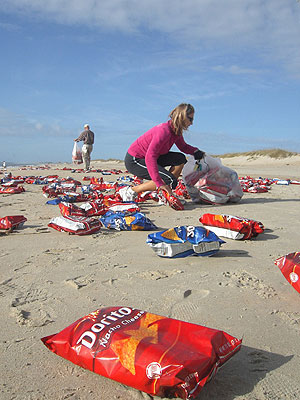
A cargo container full of Doritos fell off a ship and broke open at sea off of the Outer Banks of North Carolina. Beaches there were littered with thousands of bags of Doritos, most of which were completely intact.

There are a couple of additional pictures on the Virginian-Pilot's photo page here.

Those familiar with maritime law will no doubt be reminded by the photo above of MARPOL 73/78, the International Convention for the Prevention of Maritime Pollution by Chips. (Sorry. I couldn't resist.)

[Thanks to Michael Wang for bringing this to my attention.]

Wednesday, November 29, 2006

Energy Return on Investment

Thomas Homer-Dixon, a leading expert on environmental threats to security, writes in today's New York Times about the the world's energy situation. He points out that oil prices often reflect factors that are far more volatile than the long-term supply and demand situation, where the trends are not very promising. Homer-Dixon writes,

A better measure of the cost of oil, or any energy source, is the amount of energy required to produce it. Just as we evaluate a financial investment by comparing the size of the return with the size of the original expenditure, we can evaluate any project that generates energy by dividing the amount of energy the project produces by the amount it consumes.

Economists and physicists call this quantity the “energy return on investment” or E.R.O.I. For a modern coal mine, for instance, we divide the useful energy in the coal that the mine produces by the total of all the energy needed to dig the coal from the ground and prepare it for burning--including the energy in the diesel fuel that powers the jackhammers, shovels and off-road dump trucks, the energy in the electricity that runs the machines that crush and sort the coal, as well as all the energy needed to build and maintain these machines.

In the United States, the energy return on investment in oil and natural gas production has fallen from 25 to 1 in 1970 to 15 to 1 today. This, in part, is because we have pumped most of our easy-to-get-to oil so that now much domestic drilling activity involves wells that have more marginal potential.

Although Homer-Dixon doesn't make this specific point, it's worth noting nonetheless that some of the recent enthusiasm expressed for biofuels doesn't make much sense in terms of energy return on investment. Some biofuels, in fact, require more fossil fuels to produce than they are capable of replacing.

Tuesday, November 28, 2006

A President with Style

Toomas Hendrik Ilves, Estonia's president, wears bowties.

[Photo via the CBC.]

Monday, November 27, 2006

More on the "War"

Over at Balkinization, David Luban notes the recent discussion over whether we should call the conflict in Iraq a "civil war," but he quickly moves on to the issue of whether "war" is the right label for the conflict between the United States and Al Qaeda. He asks if it was "a disastrous mistake to label the conflict with Al Qaeda a 'war'" and acknowledges that many in the human rights community think that it was. He continues:

I don’t see matters that way. The U.S. government correctly interpreted 9/11 as an act of war, and retrospectively observed that Al Qaeda’s earlier attacks on the U.S.S. Cole and the U.S. embassies in Tanzania and Kenya were also acts of war. That is because they formed a pattern, indicating a plan and a campaign. I think this is right. While it may sound peculiar to say that a nation could be at war for several years without knowing it, there is nothing odd about noticing a pattern among attacks where at first there seemed to be no pattern. Most importantly, what makes these patterns of attack a "war" was the political reason they took place. They were launched by an enemy that had a political aim (restoring the Arab world to the greatness of a unified caliphate), a grand strategy (inciting popular uprisings against despotic Arab regimes), and a set of tactics (high-visibility terrorist attacks against Western targets, selected on political grounds). If war is politics by other means, this is war. (However, the Al Qaeda grand strategy has been a dismal failure. No popular uprisings occurred in the Arab world after 9/11, and the only despot who has fallen is Saddam Hussein, thanks to the U.S. rather than to Al Qaeda. Through the ironies of the Law of Unintended Consequences, Al Qaeda’s long-term plan of a restored Sunni caliphate has instead led, via the U.S. Iraq misadventure, to a resurgence of Shi’ite power from Iran westward through Iraq and Syria all the way to Lebanon.)

While this is a better argument than most for saying that the conflict with certain Muslim extremists constitutes a "war," it requires equating acts of terrorism with battles in a war. As I have argued before, this is a bad idea because it confers on terrorists a form of legitimacy that they do not deserve and that, for political and legal reasons, it would be better to withold from them. Blowing up embassies is a crime even when a real war is ongoing; it can't be a good idea to say that political purposes pursued by terrorists can turn crimes into acts of war.

Although Luban doesn't have a problem with the "war" label, he does have serious concerns about how that label has been used to bolster executive power since 9/11.

The real fallacy does not lie in labeling the struggle with Al Qaeda a "war," but in the false constitutional theory that gives the President a vast set of "war powers" to be used everywhere he discerns a "battlefield," which of course can be anywhere on Earth. Nothing in the Constitution suggests anything of the sort, and it is hard to see why a democratic constitution ought to do so.

Incidentally, Luban mentions the Maher Arar lawsuit and adds a point that I neglected to mention as I discussed the case in International Organizations and Law today: A federal judge dismissed Arar's suit on national security grounds. That is, the judge ruled that forcing the United States Government to defend itself against the charge that it unlawfully rendered Arar to Syria where he was tortured for a year by Syrian authorities would jeopardize the security of the United States!

Saturday, November 25, 2006

Memories of the Cold War

This, from the Guardian, is one of the more bizarre stories of the past week:

The mysterious death of a former Russian spy living in exile in London turned into an unprecedented public health scare yesterday when it emerged that he had been deliberately poisoned by a major dose of radioactive material.

Further traces of the substance were found at a sushi restaurant and at a central London hotel where Alexander Litvinenko met a number of people before falling ill, and at his home in the city.

He was killed by polonium 210, a rare radioactive isotope which is so toxic that there may never be a postmortem examination of Mr Litvinenko's body, for fear of causing further deaths.

Police and security sources said they had never encountered such an extraordinary death. "Nothing like this has ever happened before," said one Whitehall source. "It is unprecedented, we are in uncharted territory." One priority last night was to establish who has access to polonium 210 anywhere in the world.

Two days before his death, Litvinenko dictated an extraordinary statement from his hospital bed placing responsibility for his murder on President Vladimir Putin. After thanking hospital employees who cared for him and British authorities who were investigating the case, Litvinenko continued:

I thank my wife Marina, who has stood by me. My love for her and our son knows no bounds.

But as I lie here I can distinctly hear the beating of wings of the angel of death.

I may be able to give him the slip but I have to say my legs do not run as fast as I would like.

I think, therefore, that this may be the time to say one or two things to the person responsible for my present condition.

You may succeed in silencing me but that silence comes at a price. You have shown yourself to be as barbaric and ruthless as your most hostile critics have claimed.

You have shown yourself to have no respect for life, liberty or any civilised value.

You have shown yourself to be unworthy of your office, to be unworthy of the trust of civilised men and women.

You may succeed in silencing one man but the howl of protest from around the world will reverberate, Mr Putin, in your ears for the rest of your life.

May God forgive you for what you have done, not only to me but to beloved Russia and its people.

Putin has denied responsibility for Litvinenko's poisoning, but the British government has requested Russia's help in its investigation.

Litvinenko, living in exile in London, was a long-time critic of Putin. At the time of his poisoning, he was investigating the murder of a Russsian journalist who had exposed Russian war crimes in Chechnya.

Wednesday, November 22, 2006

Darfur: USHMM Exhibit

The United States Holocaust Memorial Museum is currently exhibiting photos from Darfur both online and, at night, by projecting them on the facade of the building. An online slide show is available here. See also a collection of Brian Steidle's photos and an op-ed he wrote for the Washington Post last year at the USHMM site here.

[Via FP Passport.]

Saturday, November 18, 2006

Not Very Curious George

According to the New York Times, President Bush didn't mingle much while in Vietnam this weekend. But at least he waved and smiled from his motorcade:

On Saturday, Mr. Bush’s national security adviser, Stephen J. Hadley, conceded that the president had not come into direct contact with ordinary Vietnamese, but said that they connected anyway.

If you'd been part of the president's motorcade as we've shuttled back and forth," he said, reporters would have seen that "the president has been doing a lot of waving and getting a lot of waving and smiles."

He continued: "I think he's gotten a real sense of the warmth of the Vietnamese people and their willingness to put a very difficult period for both the United States and Vietnam behind them."

Perhaps, but the Vietnamese have barely seen or heard from Mr. Bush.

David Sanger and Helene Cooper suggest in the story that the President's failure to connect with people in Asia may explain "why America's 'public diplomacy' seems unable to shift into gear."

There are, of course, additional reasons for that.

Kafkaeque

Scott Horton has posted the text of some recent remarks about the relevance of Franz Kafka's In the Penal Colony at Balkinization. Those remarks are brief and well worth reading. So is Kafka's disturbing tale.

Friday, November 17, 2006

The Dollar Cost

Taegan Goddard at at Political Wire reports that a forthcoming Bush administration budget request could make the war in Iraq the United States' most expensive conflict since World War II.

Thursday, November 16, 2006

Be at Peace

Do what is right not only to respectable citizens, but especially to the disrespectable ones as well; be at peace not only with those who are peaceable, but especially with those who do not wish to let us live in peace.

--Dietrich Bonhoeffer

[Via Sojourners' "Verse and Voice," 11/15/06]

Wednesday, November 15, 2006

The President Blogs

No, not our president. President Ahmadinejad of Iran.

[Thanks to Kristin Paulson for the tip. I must have been in a cave back in August when the BBC first reported this. Kristin knows about this because she's heading the Pepperdine delegation to the National Model United Nations in New York next March--representing the Islamic Republic of Iran.]

Meanwhile, Al Jazeera English has gone live.

Tuesday, November 14, 2006

After the Election

It was a Friday night back then, but on November 14, 1980--twenty-six years ago today--I was in the concert hall at the Kennedy Center in Washington, D.C. for a celebration of Aaron Copland’s eightieth birthday. The National Symphony Orchestra, under the direction of Mstislav Rostropovich, was honoring America’s greatest composer with a concert of his greatest music, including Appalachian Spring. Copland was there--and so was Leonard Bernstein.
When President and Mrs. Carter arrived at their box, the crowd in the hall greeted them with a long standing ovation. It was a poignant moment. Ten days earlier, on November 4, the United States marked the first anniversary of the hostage crisis in Tehran. And on that same day, Jimmy Carter lost the election in which I cast my first vote for president.

"God's Foreign Policy"

It's worth noting at the outset that the term "evangelical" was, until a few years ago, most commonly used to describe a certain religious orientation and not a political perspective. Among those who share the religious characteristics that we associate with "evangelicals," political perspectives in the United States range from those exemplified by Jim Wallis on the left to James Dobson on the right (and well beyond). But in spite of the efforts that Wallis and others have made to shift the terms of debate, in political contexts the term "evangelical" still conjures up the Religious Right that Karl Rove regards as the GOP's base.

So perhaps it should come as no surprise that, when the New York Times published a story yesterday entitled "For Evangelicals, Supporting Israel is 'God's Foreign Policy,'" the focus was on the usual suspects--James Dobson, Gary Bauer, and Pat Robertson--and a less well known (but equally conservative) minister named John Hagee. These right-wingers, and not Jim Wallis, were thought to represent evangelicals' foreign policy views.

But beyond its implicit assumptions about who the evangelicals are, the Times article was interesting for the way it laid bare the foreign policy views of the aforementioned representatives of the Religious Right. Rather than arguing for U.S. support for Israel based on their eschatological beliefs alone (where at least they might claim to have some relevant training), Dobson and Company invariably feel compelled to suggest that their views are based on sound political or historical reasoning, too. They are not.

Consider: "There sits little Israel with its five million beleaguered Jews, surrounded by five hundred million Muslims whose leaders are determined to drive it into the sea." So said James Dobson during the conflict between Israel and Hezbollah this summer, which he compared to "the Biblical skirmish between little David and mighty Goliath." (Dobson placed Israel in the role of David, not Goliath.) Dobson apparently knows nothing of the region's history, including Israel's war-fighting record, nor does he seem to know who has the region's only nuclear arsenal.

Or consider this: "Every time there has been a fight like this over the last 50 years, the State Department would send someone over in a jet to call for a cease-fire. The terrorists would rest, rearm and retaliate." This plea for war without end was John Hagee's message to President Bush as the conflict raged. Hagee apparently believes that the "five million beleaguered Jews" can kill enough of the "five hundred million Muslims" who surround them to eliminate terrorism--if only they're allowed to keep fighting.

Many have asked which Bible people like Dobson and Hagee are reading. I also wonder which IR texts they're reading.

Monday, November 13, 2006

Arms Uncontrolled

This--from today's Boston Globe--is not a number-one ranking that should make us proud:

The United States last year provided nearly half of the weapons sold to militaries in the developing world, as major arms sales to the most unstable regions--many already engaged in conflict--grew to the highest level in eight years, new US government figures show.

According to the annual assessment, the United States supplied $8.1 billion worth of weapons to developing countries in 2005--45.8 percent of the total and far more than second-ranked Russia with 15 percent and Britain with a little more than 13 percent.

Arms control specialists said the figures underscore how the largely unchecked arms trade to the developing world has become a major staple of the American weapons industry, even though introducing many of the weapons risks fueling conflicts rather than aiding long-term US interests.

The ranking and data come from a new study by the Congressional Research Service.

Airspace

Aaron Koblin, a computer design artist at UCLA, has created a fascinating three-minute film based on Federal Aviation Administration data that provides a sense of the flow of air traffic in U.S. airspace. Roger Alford at Opinio Juris has the YouTube video posted (thanks, Roger), but there's a better quality QuickTime version (along with several disaggregated components of the project) posted on Koblin's website.

If you're wondering what the environmental impact of so many flights over the United States might be, take a look at this post on "global dimming."

Saturday, November 11, 2006

Welcome to the Neighborhood

Melissa Giaimo, the Pepperdine student and Graphic reporter who wrote the story on Ken Starr and Blackwater that I linked to here, has made me aware of another story close to home that has international law ramifications. According to Global Witness, Teodoro Nguema Obiang, Equatorial Guinea's minister of agriculture and forestry and the son of President Teodoro Obiang Nguema, purchased an estate in Malibu last February for a reported $35 million. "Little Teodoro," whose official salary is approximately $60,000 per year, is said to have purchased the property through a corporation he controls called Sweetwater Malibu, LLC. I'm not certain at this point, but based on the description of the estate in this Guardian story, I think the property in question might be the one pictured here.

Why should residents of Malibu--and Americans everywhere--care about this real estate transaction? First, the money involved is, beyond doubt, tainted by the Obiang regime's corrupt practices. According to a recent ranking by Transparency International, Equatorial Guinea is one of the most corrupt states in the world. Although Equatorial Guinea is the third-largest oil producing state in Africa and, consequently, has a GDP per capita of $20,510 (30th in the world), it ranks 120th on the UN's Human Development Index. Life expectancy at birth is 42.8 years, which ranks 167th in the world.

Equatorial Guinea also has one of the worst human rights records in the world. The State Department's most recent human rights report (issued on March 8, 2006), with understatement reserved for important oil-producing states, said, "The 2002 presidential election was marred by extensive fraud and intimidation. The international community widely criticized the 2004 parliamentary elections as seriously flawed." The report goes on to note that torture, arbitrary arrests, trafficking in persons, and forced labor (among many other abuses) were reported in Equatorial Guinea in 2005.

In August, President Bush announced a National Strategy to Internationalize Efforts against Kleptocracy. This strategy commits the United States to efforts to fight against kleptocracy through the development of means to compel the forfeiture of assets associated with corrupt practices.

This would be a good time to test the President's commitment to combat the corruption of foreign rulers. It may be, however, that Equatorial Guinea's importance as an oil producer, its ties to ExxonMobil, Amerada Hess, Marathon, and other American oil companies, and its intensive lobbying efforts in the United States may dissuade the Bush Administration from even trying to act against the Obiang regime and its Malibu real estate holdings.

Maybe we can't expect the Bush Administration to act contrary to the interests of ExxonMobil, but would it be too much to ask local realtors to ask a few questions before dealing with dictators?

Pro Patria

At the eleventh hour of the eleventh day of the eleventh month, the guns fell silent on the Western Front and, at least in France, the Great War ended.

Veterans Day, first commemorated in the United States the year after the armistice and made a federal holiday in 1938, was originally called Armistice Day. Last year on this date, I marked the occasion by posting what may have been the most popular poem of that war, "In Flanders Fields" by John McCrae. This year, I offer a poem by Owen Seaman entitled "Pro Patria."

The title is based on a line from the Roman poet Horace: Dulce et decorum est pro patria mori. (It is sweet and proper to die for one's country.)

Pro Patria

England, in this great fight to which you go
Because, where Honour calls you, go you must,
Be glad, whatever comes, at least to know
You have your quarrel just.

Peace was your care; before the nations' bar
Her cause you pleaded and her ends you sought;
But not for her sake, being what you are,
Could you be bribed and bought.

Others may spurn the pledge of land to land,
May with the brute sword stain a gallant past;
But by the seal to which you set your hand,
Thank God, you still stand fast!

Forth, then, to front that peril of the deep
With smiling lips and in your eyes the light,
Steadfast and confident, of those who keep
Their storied scutcheon bright.

And we, whose burden is to watch and wait--
High-hearted ever, strong in faith and prayer,
We ask what offering we may consecrate,
What humble service share.

To steel our souls against the lust of ease;
To find our welfare in the common good;
To hold together, merging all degrees
In one wide brotherhood;

--To teach that he who saves himself is lost;
To bear in silence though our hearts may bleed;
To spend ourselves, and never count the cost,
For others' greater need;--

To go our quiet ways, subdued and sane;
To hush all vulgar clamour of the street;
With level calm to face alike the strain
Of triumph or defeat;--

This be our part, for so we serve you best,
So best confirm their prowess and their pride,
Your warrior sons, to whom in this high test
Our fortunes we confide.

Seaman did not fight in World War I. The poem thus is written from the perspective of one "whose burden [!] is to watch and wait." This, perhaps, is the only way one could write a poem that glorifies World War I the way "Pro Patria" does.

Wilfred Owen, a better poet than Seaman, also wrote a poem based on the line from Horace. But because Owen fought--and died--in the war, his poem, "Dulce et Decorum Est," conveys something very different.

The contrast between these two World War I poems demonstrates the wisdom of Erasmus, who wrote, "Dulce bellum inexpertis."

Friday, November 10, 2006

More on Blackwater

Pepperdine's newspaper, the Graphic, ran a story this week about Ken Starr's representation of Blackwater. It's available online here.

Is There Concrete Proof?

What if the most common man-made substance on Earth could made to reduce air pollution? And what if this substance just happened to be in highest demand in those parts of the world--large urban areas--where air pollution is worst?

Too good to be true? I'd say so, but apparently an Italian firm has accomplished just such an environmentally friendly feat by coming up with a smog-reducing chemical compound that can be added (at very low cost) to cement.

If you're skeptical, see this FP Passport post for a link to the Business Week story reporting on Italcementi's innovation.

Thursday, November 09, 2006

Disproportional Representation

Marty Lederman of Georgetown Law School and a regular contributor to Balkinization provides a great illustration of the disproportional representation that characterizes the United States Senate:

I wrote a friend of mine this morning to congratulate her on winning her first electoral race--for school board of our county--and mentioned in passing how remarkable it was that she had garnered in the vicinity of 125,000 votes. A few minutes later, I happened to notice that Craig Thomas of Wyoming had won reelection to the Senate--the United States Senate--with a landside (70%) victory consisting of 134,942 votes.

The winner of our nice little neighborhood school-board election received almost as many votes as . . . the next Senator from the great State of Wyoming!

Lederman goes on to note that there were roughly 32 million votes cast nationwide for Democratic Senate candidates compared to roughly 24 million votes for Republican Senate candidates. (I assume he's counting the two independents--Sanders and Lieberman--in the Democratic totals.) That comes out to about 57 percent of the two-party vote for the Dems. Of course, the Democrats (including the two independents) will have just 51 percent of the seats in the Senate--the narrowest of margins--to show for a 14-point spread in the two-party nationwide vote.

These, of course, are the rules that both parties operate under in our venerable system. As democracy increasingly becomes the norm rather than the exception among the world's states, it's worth noting that many people around the world find our tolerance for disproportional representation rather peculiar--and perhaps even undemocratic.

Borat in Russia? Nyet!

From today's International Herald Tribune:

The Federal Culture and Cinematography Agency, which certifies films for public distribution, declined this week to do so for "Borat," which is produced by 20th Century Fox, blocking it from the country's movie theaters only weeks before it was to open on Nov. 30.

An agency official, Yury Vasyuchkov, cited the film's potential to offend religious and ethnic feelings in a country where such feelings have been strained in recent months by ethnically tinged political conflicts and even violence.

Kazakh officials deny trying to exert any influence over the Russian film board's decision.

Dead at Last

Apparently, the John Bolton nomination is finally dead.

[Via Kevin Heller at Opinio Juris.]

[Update: Here's a bit more information in an Associated Press story via the International Herald Tribune.]

Wednesday, November 08, 2006

Post-Election Foreign Policy

Here are two brief essays that might help in thinking about the impact of the mid-term elections on American foreign policy:

  • First, Andrew C. Bacevich, author of The New American Militarism: How Americans Are Seduced by War, notes that the debate over "who lost Iraq" has begun and that this debate might actually be a good thing for the nation.
  • Second, Ivo Daalder of the Brookings Institution suggests that the Democrats' victory constitutes "a vote of no confidence" in the Bush administration's foreign policy. What must happen now, Daalder says, is that there must be "a clear and unambiguous commitment to disengage from the conflict" in Iraq and an effort to "restore the world's trust in America," starting with a commitment to "behave in ways that are consistent with [American] ideals."

"Out, damned spot! out, I say!"

The line is, of course, Lady Macbeth's, but this morning (according to breaking news reports all over the Internet) it could be Secretary of Defense Donald Rumsfeld's line as well. At long last--although not until after yesterday's election, which signaled a broad public repudiation of the war in Iraq that he has managed--Secretary Rumsfeld is resigning.

Recall that in Macbeth the line is uttered as Lady Macbeth frets over a spot of blood on her hands.

[Update: President Bush is holding a news conference on the subject as I write. Robert M. Gates, former CIA director and, since August 2002, president of Texas A&M University, will be the next SecDef.]

[Second thoughts: I may have over-reached with the comparison between Lady Macbeth and Secretary Rumsfeld. Clearly the better comparison is between President Bush and Britney Spears.]

Tuesday, November 07, 2006

Election Results

Warming to the ICC?

Is the United States changing its attitude toward the International Criminal Court? Nora Boustany writes in today's Washington Post that "the debate among senior U.S. military officials seems to be shifting away from staunch opposition, and a fresh assessment of the court seems to be underway."

[Via FP Passport.]

Voting

"It's not the voting that's democracy, it's the counting."

--Tom Stoppard, Jumpers (1972)

Get out and vote, if you haven't already--and keep your fingers crossed on the counting.

Blackwater Back Story

The following may be either a gratuitous plug for Seeking Security in an Insecure World or it may be useful background information regarding the wrongful death suit against Blackwater USA. You can decide. Nonetheless, the following passage appears on pages 31 and 32 (in the chapter on conventional weapons and war) of the book that appears under my photo on the right:

We turn now to an issue that holds the possibility of transforming the ways wars are waged in the twenty-first century: the rise of privatized military firms (PMFs). Over the course of the past two decades, states--both rich and poor--have increasingly turned to private companies to provide services that were previously considered the responsibility of governments alone.

On March 30, 2004, four employees of Blackwater USA, a private security firm hired to protect the employees of one of the Defense Department’s many suppliers in Iraq, were ambushed as they drove through the city of Fallujah. They were shot, their bodies were dragged from their vehicle, mutilated and burned. Two were suspended grotesquely from a bridge. Photographs of the grisly scene were published or broadcast in less discreet media outlets around the world.

The incident in Fallujah drew attention to an issue that had, up to that point, attracted relatively little attention. From the very beginning of the war, privatized military firms were employed in Iraq to perform services traditionally considered the responsibility of uniformed military forces. In Iraq at the time of the Fallujah killings, at least twenty thousand private military contractors were employed to protect diplomats (including the head of the Coalition Provisional Authority, Paul Bremer), American and Iraqi businessmen, aid workers, and many others.

While the large number of private security contractors in Iraq may be surprising, the role of privatized military firms has been even more important in a number of other conflicts. During the 1990s, the government of Sierra Leone halted a bloody civil war and recaptured the country’s diamond mines from rebel forces by hiring Executive Outcomes, a PMF based in South Africa. Executive Outcomes used airpower, armored vehicles, and a small but highly trained force to accomplish what the government had been unable to do in years of fighting.

Privatized military firms are employed by governments for a variety of reasons, some that appear legitimate and some that may not be. First, PMFs allow the military to contract-out jobs that are temporary, that involve skills that are in short supply among the armed forces, or that can be performed more efficiently by contractors. Second, when private contractors sustain casualties, those casualties are not typically reported in the media and do not affect public opinion in democracies the way military casualties do. (The Pentagon does not include contractor casualties on its casualty lists in the Iraq War.) The use of PMFs, in other words, may serve to conceal the true human costs of military operations, but it may also permit defense establishments to keep fewer troops under arms, since shortfalls can be handled by calling in the private sector.

The rise of privatized military firms also means, however, that defense establishments may find themselves competing for the services of military professionals. In February of 2005, the Department of Defense approved a plan to offer financial incentives (up to $150,000 for a six-year reenlistment) to stem the flow of experienced Special Operations Forces personnel to private security companies. The bonuses were devised to deal with a situation in which Army Green Berets or Navy SEALs with twenty years' experience and making fifty thousand dollars in base pay could leave the military and go to work for a private security firm at salaries close to two hundred thousand dollars a year.

Perhaps more troublesome for the international system is the fact that an industry has emerged that gives those who can pay, whether governments or corporations--or even rebel organizations and drug traffickers (PMFs are reported to have trained drug dealers in Mexico and UNITA rebels in Angola in military tactics and the use of advanced weapons)--access to military force. In spite of certain advantages associated with contracting-out warfare, a tremendous potential for abuse exists as well.

For more on this subject, I recommend P. W. Singer's Corporate Warriors: The Rise of the Privatized Military Industry and Robert Mandel's Armies Without States: The Privatization of Security. Also, there is an excellent documentary from PBS entitled Private Warriors available in its entirety online.

Monday, November 06, 2006

Saddam Hussein's Trial

It comes as no surprise, but the Iraqi High Tribunal (IHT) has found Saddam Hussein guilty of crimes against humanity for actions taken against opponents of his regime in 1982 in the town of Dujail. Because a sentence of death was entered by the court, the Court of Cassation will now be required to review the verdict and sentence.

For more on the case, see the stories in the Washington Post, the Los Angeles Times, and the New York Times. Note also the official site of the IHT (in Arabic and in English) and expert commentary on the trial (although not yet on the verdict) provided on Grotian Moment: The Saddam Hussein Trial Blog. And, over at Opinio Juris, Kevin Jon Heller's comments on the verdict are worth reading.

Sunday, November 05, 2006

In Re Blackwater Security Consulting

The following is the presentation of facts from Judge Duncan's opinion in the decision of the U.S. Court of Appeals for the Fourth Circuit to deny Blackwater's appeal seeking to gain federal court jurisdiction over the wrongful death suit filed in North Carolina courts by the families of the four Blackwater employees killed in Fallujah on March 30, 2004. The complete opinion is available here [.pdf file].

Stephen S. Helvenston, Mike R. Teague, Jerko Gerald Zovko, and Wesley J.K. Batalona (collectively, "decedents") entered into independent contractor service agreements with Blackwater Security Consulting, L.L.C., and Blackwater Lodge and Training Center, Inc., (collectively, "Blackwater") to provide services in support of Blackwater’s contracts with third parties in need of security or logistical support. Blackwater assigned the decedents to support its venture with Regency Hotel and Hospital Company ("Regency") to provide security to ESS Support Services Worldwide, Eurest Support Services (Cyprus) International, Ltd. ("ESS"). ESS had an agreement to provide catering, build, and design support to the defense contractor firm Kellogg, Brown & Root, which, in turn, had arranged with the United States Armed Forces to provide services in support of its operations in Iraq.

According to the complaint, at the time the decedents entered into the independent contractor service agreements on or about March 25, 2004, Blackwater represented that certain precautionary measures would be taken with respect to the performance of their security functions in Iraq. For example, they were told that each mission would be handled by a team of no fewer than six members, including a driver, navigator, and rear gunner, and would be performed in armored vehicles; they would have at least twenty-one days prior to the start of a mission to become familiar with the area and routes to be traveled; and they would have an opportunity to do a pre-trip inspection of their anticipated route.

Instead, the complaint alleges, Blackwater failed to provide the decedents with the armored vehicles, equipment, personnel, weapons, maps, and other information that it had promised, or with the necessary lead time in which to familiarize themselves with the area. On March 30, 2004, the decedents’ supervisor, Justin McQuown, directed them to escort three ESS flatbed trucks carrying food supplies to a United States Army base known as Camp Ridgeway. Lacking the necessary personnel and logistical support, the decedents ultimately became lost in the city of Fallujah. Armed insurgents ambushed the convoy; murdered the decedents; and beat, burned, and dismembered their remains. Two of the mutilated bodies were hung from a bridge.

Richard Nordan, in his capacity as administrator for the decedents’ estates, sued Blackwater and McQuown (hereinafter referred to collectively as "Blackwater") in the Superior Court of Wake County, North Carolina, alleging causes of action for wrongful death and fraud under North Carolina tort law. Blackwater removed Nordan’s action to federal district court. It asserted that 28 U.S.C. § 1441(a) (2000) permitted removal both because the Defense Base Act ("DBA"), 42 U.S.C. §§ 1651-1654 (2000), completely preempted Nordan’s state-law claims, and because the issues in the case presented unique federal interests sufficient to create a federal question. Once in federal court, Blackwater moved to dismiss the case, arguing that the district court lacked subject matter jurisdiction because the DBA covered Nordan’s claims and, therefore, that Nordan could litigate his claims only before the Department of Labor, which decides DBA claims in the first instance.

The district court first considered whether Blackwater had met its burden of establishing federal removal jurisdiction. Nordan v. Blackwater Sec. Consulting, 382 F.Supp.2d 801, 806 (E.D.N.C. 2005). In concluding that Blackwater had not met this burden, the district court rejected both of Blackwater’s asserted bases for removal jurisdiction. The court reasoned that, because the DBA grants the Secretary of Labor exclusive original jurisdiction over DBA claims, the statute does not completely preempt state-law claims; the hallmark of complete preemption, the district court concluded, is the presence of original jurisdiction over the matter in federal district court. Id. at 807-10 (citing Lontz v. Tharp, 413 F.3d 435, 442-43 (4th Cir. 2005)). Further, the court determined that Blackwater’s assertion of removal jurisdiction by way of a unique federal interest in the adjudication of Nordan’s claims "assume[d] the very conclusion which [the] court lack[ed] jurisdiction to reach, namely that the decedents in this case are covered as employees under the DBA." Id. at 813. Finding no basis for removal, the district court concluded that it lacked subject matter jurisdiction and, citing 28 U.S.C. § 1447(c) (2000), [fn. 1] determined that it must remand the case. Nordan, 382 F.Supp.2d at 813-14. Although Blackwater encouraged the district court to remedy its lack of jurisdiction by dismissing the case rather than remanding it, the district court further concluded that it lacked the authority to dismiss. The court reasoned that federal district courts play no role in the adjudication or review of DBA claims [fn. 2] and, therefore, that it had no jurisdiction to decide whether the DBA applied to Nordan’s claims. Id. at 814. The district court thus remanded the case to state court without reaching the merits of Blackwater’s motion to dismiss.

[fn. 1] Section 1447(c) provides: "If at any time before final judgment it appears that the district court lacks subject matter jurisdiction, the case shall be remanded. . . . The State court may thereupon proceed with such case."

[fn. 2] The district court incorrectly concluded that the federal district courts play no role in the adjudication of DBA claims. The federal district courts, followed by the federal courts of appeals and the United States Supreme Court, review DBA claims after they have been initially adjudicated in the Department of Labor. See 42 U.S.C. § 1653(b) (2000); see also Lee v. Boeing Co., Inc., 123 F.3d 801, 803-05 (4th Cir. 1997) (describing agency and judicial review of DBA claims).

Blackwater now seeks review, via both an ordinary appeal and a petition for a writ of mandamus. For the reasons that follow, we hold that we lack jurisdiction to hear the appeal and decline to issue a writ of mandamus. [fn. 3]

[fn. 3] Nordan moved to strike a portion of the record that Blackwater submitted on appeal. Because we dismiss the appeal and the petition for lackof jurisdiction, we deny this motion as moot.

Representing Blackwater

Last Monday, I blogged about the wrongful death suit against Blackwater USA. There I noted what had been reported in The Nation, that Pepperdine School of Law dean Ken Starr is representing Blackwater. To be more specific, Dean Starr is preparing a cert petition to the U.S. Supreme Court on behalf of Blackwater.

Whether it was my blog entry that prompted this or not I simply don't know, but on Friday I learned that a reporter for the Graphic, Pepperdine's campus newspaper, is working on a story about the Blackwater case and Dean Starr's role in it. Hopefully, Dean Starr will have something to say on the record about how he came to be the attorney of record for Blackwater. The story, if it makes it into print, should appear on Thursday.

The more I've thought about this, the more convinced I've become that Dean Starr's involvement is an indicator of the significance of this case for the private military industry. Because he has a full-time job as the dean of a law school with aspirations, Starr must be (and generally has been) very selective about the cases he takes. He specializes, by virtue of his experience as a federal circuit court judge and as the U.S. Solicitor General, in representation before the U.S. Supreme Court. But he has no obligation to represent a client like Blackwater, which has a business model pulled from the pages of Soldier of Fortune magazine. He would seem to have little to gain from doing so. After all, he's defending a firm that is making a lot of money off of the disaster that is our Iraq policy in a case brought by the families of some of its employees who were brutally killed by Iraqi insurgents allegedly as a consequence of the firm's cost-cutting measures.

What this suggests is that the case has great political ramifications and that it's not just Blackwater's business model that is at stake. What is at stake is Secretary of Defense Donald Rumsfeld's warfighting model.

Private contractors like Blackwater make it possible for the United States military to operate in Iraq with with a much smaller force than would be necessary if the U.S. were relying solely on the uniformed military and not on private security companies to do everything from building bases to protecting American diplomats and VIPs and transporting vital supplies. Take away the private contractors and the shortage of translators becomes even more acute, overstretched Army units are forced to do even more, and critical infrastructure in Iraq gets even less protection than it now has. Secretary Rumsfeld's views have certainly been undermined by reality on the ground in Iraq, but the day of reckoning would have come much sooner and would have been even more obvious had it not been for the heavy reliance on largely invisible (even if very costly) private military firms.

To put it very directly, I don't think Ken Starr is representing Blackwater because someone at Blackwater asked him to. I think he's doing it because someone in the Bush Administration asked him to. A major judgment against Blackwater in a wrongful death lawsuit would open the gates to a flood of litigation against private military contractors operating in Iraq. And with that, the possibility of withdrawing the military from Iraq while leaving private security companies as surrogates for the military would be eliminated. Not even the privatization of the war would remain as an option.

Saturday, November 04, 2006

Remember the Titans

On March 16, 1962, the United States conducted its first test of the Titan II ICBM, a two-stage liquid-fueled rocket capable of being launched from a hardened silo (unlike its predecessors, the Atlas and Titan I ICBMs). By the end of 1963, a total of 56 Titan II ICBMs had been deployed. (The number would eventually reach 60 in 1966 before dropping to 54--18 in Arkansas, 18 in Arizona, and 18 in Kansas--in 1967.) In addition to carrying the largest nuclear payloads, the Titan II was also used as the launch vehicle for NASA's Gemini manned space program and for many of the U.S. Air Force's largest satellites.

Almost as soon as it was deployed, however, the Titan II was made obsolete by the Minuteman solid-fuel ICBMs. Solid-fuel missiles were more reliable, easier to maintain, and capable of being launched more quickly (thus the name "Minuteman"). By the end of 1967, there were 1,000 Minuteman ICBMs deployed in Wyoming, Montana, North Dakota, South Dakota, and Missouri.

One of the reasons the Titan II ICBMS were kept around for two decades after the completion of the Minuteman deployment was ability of the Titans to carry large payloads. The largest warhead ever deployed by the United States--a nine megaton thermonuclear device--was placed atop a Titan II. (According to one of the displays at the Titan Missile Museum, a warhead that size would have the destructive power of a train with 90,000 boxcars--long enough to stretch 1,534 miles--filled with TNT.)

The Reagan Administration's Strategic Forces Modernization Plan, drafted in 1981, called for the elimination of the Titan II ICBMs by the end of 1987. The 54 Titan IIs were removed from their silos and in every case the silos were destroyed--except for the silo near Sahuarita, Arizona just south of Tucson.

Through the intervention of the Pima Air Museum, Site 571-7 was preserved as a museum. A Titan II test rocket was disabled, placed in the silo, and the silo door was permanently fixed in a half-open position (to assure the Soviets/Russians, via their satellite reconnaissance, that the silo was not operational). The satellite photo here shows the silo in the half-open position.

Today, volunteers at the Titan Missile Museum take visitors on an hour-long tour through the surface facilities, down into the silo, and into the underground control room. It is, as the museum likes to note, a step back in time to the front lines of the Cold War.

And that's what I did with my free time while in Tucson last week for the ISSS/ISAC Conference.

Torture: Two Impacts

When our government resorts to torture, those whom we torture must be kept from telling anyone about it.

When our government resorts to torture, those who register their objections suffer . . . and sometimes die.

Thursday, November 02, 2006

Another Problem

We can add yet another item to the list of ways in which international security has been harmed by the Bush Administration's Iraq policy.

The New York Times reports that Iraqi documents placed on a public web site by the Bush Administration in order to appease conservatives who were hoping to find a smoking gun that would justify the 2003 invasion have included some materials that could be useful to other countries' efforts to build nuclear weapons. According to William J. Broad's story,

Officials of the International Atomic Energy Agency, fearing that the information could help states like Iran develop nuclear arms, had privately protested last week to the American ambassador to the agency, according to European diplomats who spoke on condition of anonymity because of the issue’s sensitivity. One diplomat said the agency's technical experts "were shocked" at the public disclosures.

The documents, roughly a dozen in number, contain charts, diagrams, equations and lengthy narratives about bomb building that nuclear experts who have viewed them say go beyond what is available elsewhere on the Internet and in other public forums. For instance, the papers give detailed information on how to build nuclear firing circuits and triggering explosives, as well as the radioactive cores of atom bombs.

The Office of the Director of National Intelligence has suspended public access to the site.

Prosecuting FGM in American Courts

Peggy McGuinness at Opinio Juris points to the following story in today's Asheville (N.C.) Citizen-Times:

Lawrenceville, Ga.--The lawyer for an Ethiopian immigrant convicted of the genital mutilation of his 2-year-old daughter explained that although the 5,000-year-old practice goes against Khalid Adem's beliefs, it is part of his culture.

But a judge rejected that argument Wednesday, and told Adem before sentencing him to 10 years in prison that part of his culture is a crime in America. Adem had been convicted earlier in the day.

The trial is believed to be the first criminal case in the United States involving the ancient African tradition. Taina Bien-Aime, executive director of the New York-based international human rights group Equality Now, an international human rights group, called the case monumental.

The full story is available here.

Wednesday, November 01, 2006

A Man, A Plan, A Canal . . .

. . . Panama.

So goes the famous palindrome. And so will go the remaining seat on the UN Security Council.

After 47 votes in the General Assembly electing neither of them, Guatemala and Venezuela have decided to step aside in favor of Panama.